Jackdaw :: Larry Conklin & Jochen Blum
Fingerstyle folk, twelve-string guitar, violin and pastoral restraint
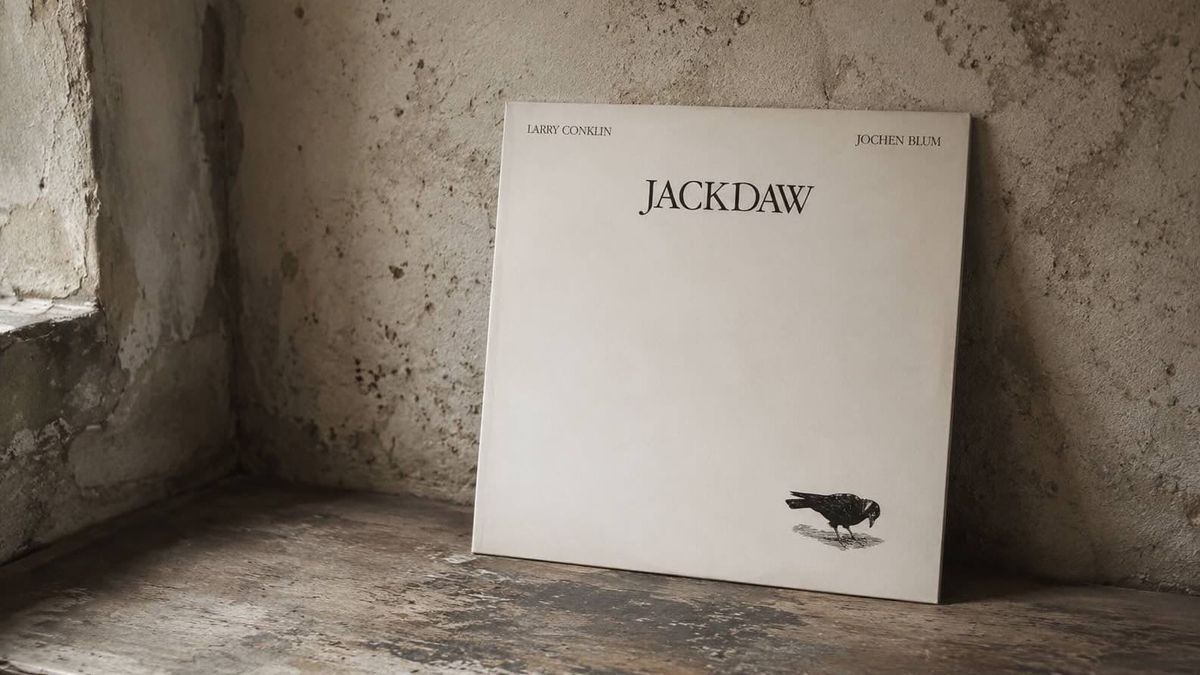
Most reissues return a record to a moment. This one returns it to a life. When Larry Conklin pressed three hundred copies of Jackdaw in 1980 and, in his own words, "sent them out into the world," he had a Gibson J-45 bought the year he left the army, a self-taught thumb-and-index style borrowed from Rev. Gary Davis, and Bert Jansch as what he called his guiding light.
What he did not have yet was any of the rest of it: the two decades in Italy and Germany that followed, the stages shared with Memphis Slim and John Renbourn and the Chinese harpist Xu Feng Xia, the blues harmonica of Andreas Scherer on a later record, a soundtrack credit for a British documentary about dolphins, four years as guitarist for the bluesman Guitar Crusher, or a song called "On the Road" written for a one-time neighbor named Jack Kerouac.
Jackdaw, reissued by Tompkins Square, is what all of that looked like before it happened: ten tracks, half solo twelve-string, half in gentle duet with the violinist Jochen Blum, whom Conklin had met by chance in Florence only months earlier.
The pairing is the record's real subject. Conklin's fingerpicking never hurries; the title track and "Traveler" move at the pace of someone still working out what the instrument can hold, while Blum's violin arrives less as accompaniment than as weather, thickening a phrase here, lifting off from it there. Conklin's voice, where it appears, belongs to the softer, more pastoral wing of the English tradition rather than to any transatlantic showmanship: murmured, weather-worn, content to describe a scene rather than to declare a feeling about it. The guitar keeps the same discipline, staying close to the ground, faithful above all to the bucolic landscape it is rendering, and rarely permitting itself a flourish it has not earned. It is Blum's violin, moving in soloistic runs and long ascending scales, that gets to say what the guitar withholds, the ornament and the small ecstasy, the occasional reach toward something larger than the field in front of it.
Between them the two instruments behave like a single sensibility split in two.
One half keeps faith with the landscape exactly as it is. The other is free to imagine what the landscape might feel, given a voice.
"The Diamond Cutter," written in a Seattle Community College writing class after a stranger's poem ("You only deal with cut glass. I deal with diamonds."), later became, without Conklin's knowledge, the campaign song of a Seattle mayor running for a third term; he found out from a letter, in Berlin, seven years after the fact. It is hard to think of a stranger fate for a home recording, and harder still to think of one that suits the record's own unhurried, slightly bemused generosity better.
Conklin's fingerpicking keeps its unhurried discipline while Blum's violin thickens and lifts away from the guitar's pastoral ground.
Guitar and violin move like two halves of the same sensibility: one staying close to the landscape, the other free to imagine beyond it.
Written after a stranger's poem in a Seattle writing class, the song later travelled far enough to become a mayoral campaign song without Conklin knowing it.
Jackdaw is usually filed, correctly, alongside Fahey and Basho, in the American Primitive shelf reissues have built around Tompkins Square's catalogue. But it plays differently once the rest of Conklin's life is in view. This isn't a lost masterpiece rescued from silence by the usual mythology of reissue culture. It's a beginning, overheard, made by a musician who was about to go everywhere. And yet the word masterpiece is not out of place here. Call it, without embarrassment, a small one, earned on the evidence of the ten tracks themselves, where guitar and violin manage to say everything a pastoral English record needs to say, and say it without once raising their voice. Nobody making it could have known how far it would eventually be sent.