David Lowery :: A Ghost Story
: Drama of a condemned house: a note in the wall, a tune that outlives the walls.

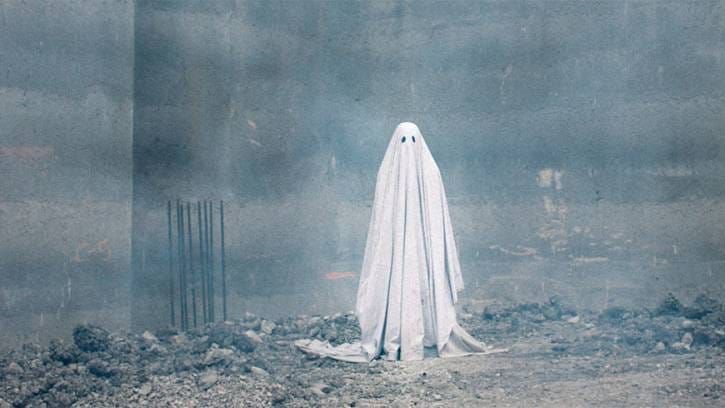
The house in A Ghost Story was already condemned when David Lowery found it. The crew could use it for free because nobody expected it to last, so the film’s long farewell to a building doubled as a demolition schedule.
Lowery shot A Ghost Story in secret in the summer of 2016, two days after finishing post-production on Pete’s Dragon, in a small house in South Irving, Texas, the town where he grew up, on a budget reported at between $100,000 and $150,000. Casey Affleck is C, a musician; Rooney Mara is M, his wife. They have initials in place of names and an argument about moving house that they never quite finish. C dies in a car accident just outside. At the hospital M draws the sheet over his face, and once she has gone he sits up beneath it and walks home. For the rest of the film he is a figure in a bedsheet with two black eyeholes, the cheapest ghost there is.
The costume took real work to look that cheap. A king-size sheet would not cover Affleck, so extra layers went underneath, the eyeholes had to be puppeteered to stay in place, and Lowery reduced the actor’s movement to a slow, upright stillness. For some later shots the art director David Pink wore it instead, and the BFI’s credits list him as “ghost stage 2”. Two bodies under one sheet is the film’s method in miniature: the shape outlasts whoever happens to be inside it. Lowery frames that shape in a near-square 1.33:1 image, chosen, he said, for a character trapped “in a box for eternity”.
Japanese viewers had a word ready for the figure: jibakurei, a spirit bound to a piece of ground rather than to a person. It fits better than anything in English. C stays for M, but M leaves, and he stays anyway. He watches a single mother, Maria, move in with her children and drives them out with flying plates; he watches a party; he watches a bulldozer go through the wall and an office tower go up on the plot, and he is still standing at the same coordinates. When the film sends him back to the nineteenth century, it is to the same patch of Texas, where a pioneer family is laying out a house and is killed before finishing it. What binds him is the ground, and the house is only the latest thing built on it.
Against that ground the film sets two ways of keeping something, and the difference between them is its real subject. The first is paper. Early on, M tells C that as a child she hid notes in the houses she moved out of, so that some part of her would be waiting if she ever went back. Before she leaves this one she folds a note into a gap in the moulding and paints over it, and the ghost spends years scraping at the paint. Paper lives inside a structure and depends on it; the bulldozer very nearly takes the note along with the wall. The second is a tune. The song C records in the house, “I Get Overwhelmed”, is what M lies on the floor and listens to on headphones after he has died. Two centuries earlier the youngest pioneer son hums the same melody while hiding a note of his own under a rock, and nobody in the film could have taught it to him. Paper needs walls. A melody needs only somebody’s mouth, and in Lowery’s loop it appears to need no first author at all.
That is also where the film is weakest. At the party Will Oldham, credited as the Prognosticator, holds the kitchen table with a long speech about Beethoven’s Ninth, the death of the universe and the vanity of leaving anything behind. He delivers it well, and it is the one moment the film explains itself, putting into words what the hummed tune and the scraped paint had already shown. The song, too, never quite convinces as C’s own: it is performed by Dark Rooms, the band of the film’s composer Daniel Hart, and it sounds like a 2017 record more than something worked out at a piano in that house. The pie scene earns its reputation by contrast. Mara sits on the kitchen floor and eats most of a pie in a single take of about four minutes, until she has to run and be sick, while the ghost stands behind her with nothing to do. It is the one stretch in which grief is given its actual length.
Lowery has said that shooting in his home town was about letting go of nostalgia. He also took some of the house’s furniture home, and in 2017 said he still had it.
Next door, a ghost in a floral sheet waits at a window for someone it can no longer name. When its house comes down, it says it doesn’t think they’re coming, and the sheet falls empty.
Books drop from a shelf when C loses his temper, and one lands open at Virginia Woolf’s “A Haunted House”, the story whose lines open the film.
In the hospital, a doorway of light opens for him. He turns away from it, and it closes.
We never read M’s note. The film shows the paper, the folding, the paint and years of scraping, and keeps the words to itself.