Damian McCarthy :: Hokum
Irish folk horror in a hotel closing for winter.

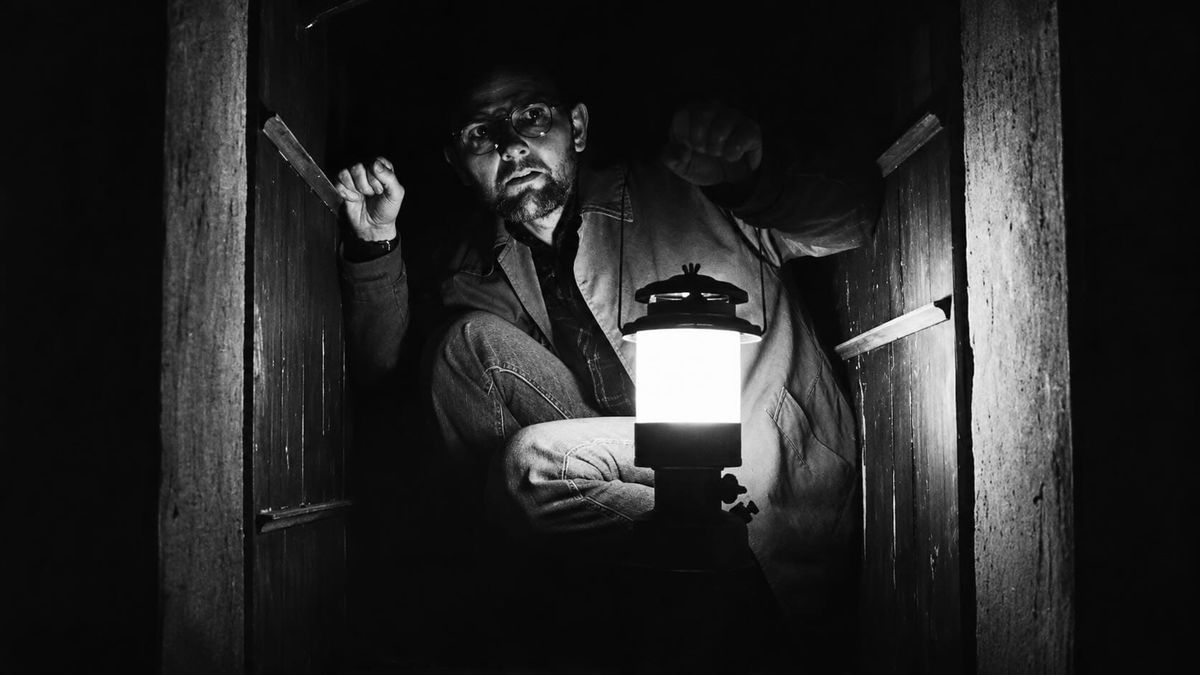
Hokum begins as the hotel shuts. First comes the Halloween party, the last of the season; then the chairs go up on the tables, and what remains is a bridal suite sealed for years and a witch story that keeps the staff away from one door, and from whatever is behind it.
Ohm Bauman (Adam Scott) arrives at the Bilberry Woods Hotel in West Cork with a small suitcase and his parents' ashes; they spent their honeymoon there. He is a successful American novelist, the son of Irish emigrants, and unpleasant enough that the film never asks us to like him. He snubs a man who wants advice about writing, drinks, and treats the village as scenery. Scott, best known for comedy, gives him the face of a man who has turned fear into a product and believes in none of it unless he wrote it himself.
The title is the word Ohm would use for everything he is told. Hokum: nonsense. To him the witch who lives in the suite and drags people underground is part of the hotel's stock of lobby lore. The film hears the story differently: "the witch lives there" is a rule, and its purpose is that nobody goes in. When Fiona (Florence Ordesh), who works the bar, vanishes after the Halloween party, the locals won't even consider that she might be inside. It works the way the Spirit of Dark and Lonely Water did in the 1973 British public information film, by making a place frightening enough that nobody wants to go near it. Someone in the hotel has reason to want that room left alone. Ohm gets the keys from Jerry (David Wilmot), the outcast who lives in the hotel grounds, and goes in. The door closes behind him, pushed shut by someone very much alive.
McCarthy's best idea is that a legend which kept people safe for decades can also keep a crime out of sight, with the same words and the same lock. For its long middle stretch Hokum belongs to the people who stay on in a hotel out of season. Mal the manager (Peter Coonan), Alby the bellboy who wants to write (Will O'Connell), Fiona, Jerry: they live by the rules of the place, and their obedience is what lets Fiona's absence pass unquestioned. Jerry is the only one who breaks those rules, and he does it by handing the keys to an outsider who writes horror novels. McCarthy shot close to where he grew up, and his village is a handful of people working in a building too big for the low season.
The best sequence comes when Ohm, sealed in the suite, tries to reach Jerry downstairs with the old service bells, the system guests once used to summon the staff. Ohm, who spent his first evening ignoring the staff, now rings for them over and over, with no way of knowing whether anyone is still there to hear. McCarthy lets the silences run longer than the genre usually dares. Colm Hogan's photography keeps the lamps low and lets the corridors end in black, and Joseph Bishara, who scored Insidious and The Conjuring, often pulls the music back and leaves the tension to the house's own noises.
The film loses its grip in the last half hour. The third act is mostly a tour of the closed hotel, one room after another, and the apparitions keep to a fixed routine: a silence, the lamps going dark, a sudden image. It works the first time; by the third the audience is counting the beats. Worse, after an hour of proving that the witch only needed a closed door, McCarthy brings her on screen just as the human story has finished its work, and from then on she is one more apparition among the others.
Ohm scatters his mother beside a tree he recognises from an old photograph, then empties his father out without ceremony.
A service shaft built to carry plates becomes the way down to the basement.
The ending of Ohm's Conquistador trilogy appears in bleached southern light, far from the Irish damp.
After Caveat and Oddity, Hokum is McCarthy's most ambitious film, though also his least disciplined. Its middle hour is the part worth keeping, with the bar, the bell board and the locked suite whose story kept the village out.