Cinico TV: Ciprì, Maresco and the Southern Hauntology of Palermo
Ciprì and Maresco's Palermo, a limewashed haunting with flesh, sweat and hunger.
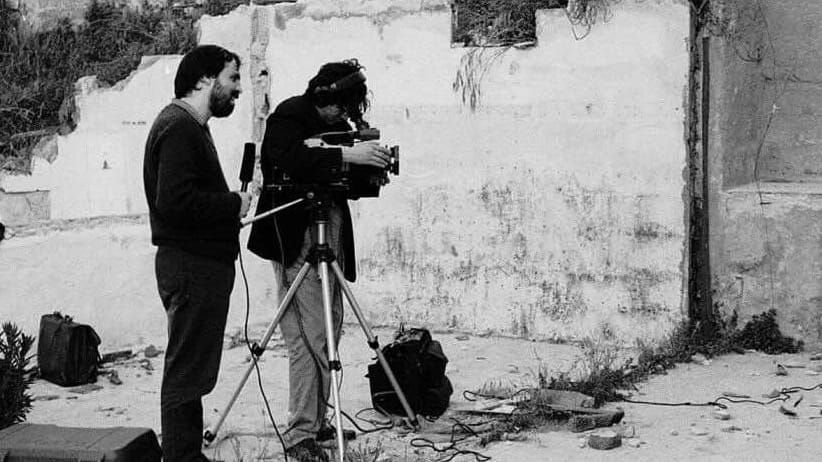
Cinico TV is the black-and-white Palermo that Ciprì and Maresco broadcast on Italian state television through the first half of the Nineties: a few minutes at a time, mask-like bodies held still in a limewashed landscape.
It began around 1989 at TVM, a Palermo station where the two of them were making jazz programmes for something short of a salary and could borrow professional equipment after hours. Daniele Ciprì's father repaired cameras, which may explain why the son never seems to have been frightened of one. He stayed at the viewfinder. Franco Maresco, who had run a cineclub called Nuovo Brancaccio and then a video shop in via Sammartino, became the voice off-screen, asking questions of men who stood where they were told, and by 1990 Rai 3 was showing the results, first in Enrico Ghezzi's Fuori orario and later in Blob and Avanzi, at an hour that kept getting later as the complaints came in.
The cast is almost entirely male. Giuseppe Paviglianiti farts with the solemnity of an operatic aria; Pietro Giordano, Marcello Miranda and Francesco Tirone come back from one short to the next, and Tirone's ode "A Silvio" is addressed to a Berlusconi who was still four years from politics. I have tried to find out how they were chosen and mostly failed. Miranda at least came through the shop, where he had been a customer since about 1984. Whether any of them was paid, and how much, I could not establish from anything I read.
The walls behind them were limewashed, or look it. Limewash is a thin coat that lets a building breathe and rubs off a little every season, so it has to be put on again each year, and on a wall nobody bothers with any more the brick comes up through it like bone under skin. I call what these shorts have scialbìa, for want of anything in the English writing on hauntology, whose ghosts are northern and mostly clean.
People called it satire at the time, and there is plenty of the mafia and Berlusconism in it, though what I keep returning to is the former brickworks at Bandita, the old depot in via Oreto, Sant'Erasmo, the gasometer, a part of Palermo that does not get photographed. Ciprì has said they used realism as if it were a visual effect. The series ran straight through 1992, the year of the bombs that killed Falcone and Borsellino, and through September 1993, when the parish priest of Brancaccio, Pino Puglisi, was shot. None of this is mentioned in the episodes I have seen, and I have not seen them all.
The jazz comparison is my own; as far as I can tell, neither of them has made it. They did begin by filming jazz. They later made a film in which Steve Lacy improvises against the images; Maresco went on to spend 128 minutes on the clarinettist Tony Scott, "an idealist in whom I see much of myself"; and in 2011, at the Goethe-Institut in Palermo, he screened Cinico TV clips while Salvatore Bonafede played piano over them. So when the same theme of misery and waiting comes round again with a different phrasing, I hear a standard, and I hear Maresco's voice coming in over a held note that goes nowhere in particular. The analogy stops at what the voice is after. A soloist wants something from the band, and Maresco mainly wants to keep the man talking.
That appetite is where the trouble starts. By Maresco's own account, left-wing reviewers accused them of exploiting people on the margins, and I find the sadism easy to hear; there is a moment in almost every short where you would like him to stop. He has called their gaze purely aesthetic and spoken of a distrust of human beings. Yet when Miranda died he called him an Ecce homo, and the person he had forgiven most in his life, and I do not know how to add those statements up. Their last short work together is called Ai confini della pietà, on the borders of pity. Tirone's refrain, "siamo davvero pietosi", can mean that we are pitiful or that we are full of pity.
The official objection came from elsewhere entirely. In March 1998 Totò che visse due volte was refused a release certificate for blasphemy and offence to public decency, the ban was lifted on appeal within days, and the trial that followed dragged on to an acquittal in 2001.
In the Capuchin catacombs lies Rosalia Lombardo, not yet two when she died, who was stopped by Alfredo Salafia with formalin, glycerin, zinc salts, alcohol and salicylic acid, a recipe recovered only recently from a notebook kept by his heirs. The patron saint, the other Rosalia, has gone round in procession as bones since 1625. Ernesto de Martino, who worked in Lucania and never wrote about any of these people, thought a lament was a way of getting through a crisis. Nobody laments in Cinico TV. The men go on speaking instead, with the colour gone out of them, and scialbìa is the nearest I can get to it.
I leave the series squinting, as I would a roofless church at noon. The Leopards, Marzamemi and the postcard South are nowhere in it. The men grew old and died, which the ghosts in Ghost Box catalogues are spared. Giordano spent his last years begging and queuing for food and died in January 2017. Maresco has dated his split from Ciprì to a run of deaths among the actors who worked with them. Ciprì went on to win Davids for Bellocchio and Rovere; Maresco to Venice, and to saying that every film of his had been a trap. Miranda, who once told someone he was one of the few survivors, got by on odd jobs, some of them at a greengrocer's, and died this April at sixty-seven.
Last revised: July 2026