Edith Holden and the Year That Did Not Know It Was Vanishing
Nature writing, phenology, Edwardian landscapes and the discipline of attention
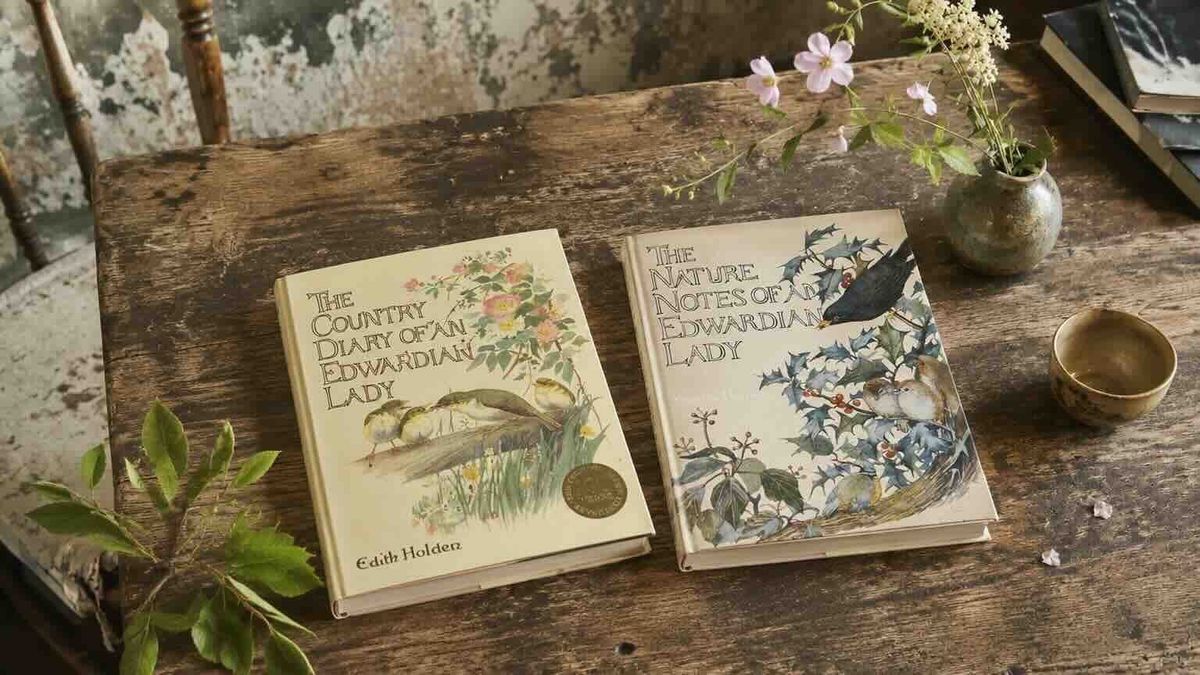
In 1906, an artist and teacher living at the rural edge of Birmingham spent a year recording flowers, birds, weather, rural customs and the changing forms of the Warwickshire landscape. Edith Holden believed she was preparing a model nature diary for her pupils. Seventy-one years later, the private exercise became one of the most successful illustrated books of the twentieth century.
There is a day in March 1906 when Edith Holden bends towards a Warwickshire hedgerow to examine what has opened there. The county does not yet know it will become the setting of a celebrated book. The plant has no sense of being preserved. Holden identifies it, paints it and places it within a larger register of wind, rain, birdsong and rural time. A gesture aspiring to little beyond accuracy now reaches us with the gravity of something we were never promised.
The surviving page offers no warning that the world around it will change. That absence is part of its force. Holden writes within time, without the retrospective knowledge that governs our reading. The melancholy belongs to us. It accumulates after the event, like silt deposited by the intervening century.
What she records is smaller and more exact: a robin, a violet, a proverb concerning the weather, a saint’s day, the direction of the wind. An ordinary year receives the care usually reserved for what is already known to be passing. Holden could not have known that the ordinariness itself would one day appear irrecoverable.
I. A Landscape Between Field and Suburb
To understand the diary, it is necessary to begin with Olton rather than with the book.
Holden moved with her parents and sisters to Gowan Bank in Kineton Green Lane in 1905. Olton, then part of Warwickshire, had remained predominantly agricultural until the arrival of its railway station in 1869. By the opening years of the twentieth century, fields, lanes, old boundaries, new villas and railway connections existed beside one another. It was neither untouched countryside nor fully absorbed suburbia. It was a threshold landscape.
That condition matters. Holden’s pages are often approached as though they had descended from an immemorial rural England, complete and undisturbed. Yet the countryside she observed had already been made and remade by centuries of cultivation, enclosure, transport and ownership. Warwickshire hedges could preserve the edges of ancient woodland or mark divisions imposed during the enclosure of common land in the eighteenth and nineteenth centuries. Their hawthorn, blackthorn, bramble, rose and honeysuckle formed habitats, but also historical lines: living boundaries through which property had entered the vegetation.
Holden therefore did not document nature apart from history. She painted a landscape whose apparent naturalness concealed labour, law and gradual suburban expansion. The railway that had helped alter Olton also made it possible to move quickly between town and country. The diary belongs to that proximity. Its intimacy with rural life arose within reach of industrial Birmingham.
This may be the first overlooked fact about The Country Diary of an Edwardian Lady: its pastoral vision was formed at an edge where the countryside could already be perceived as vulnerable.
II. A Schoolbook Before It Was a Masterpiece
Edith Blackwell Holden was not an amateur who happened upon watercolour. She had entered the Birmingham School of Art while still young and later studied at Craigmill in Scotland. She worked professionally as an illustrator and taught drawing at a girls’ school in Solihull. Her 1906 notebook appears to have served as a model for the nature diaries she required her pupils to keep. The masterpiece began, in part, as pedagogy.
This places Holden within the British Nature-Study Movement, which was gathering institutional force at the turn of the century. In 1901, teachers attending a summer course at the South-Eastern Agricultural College at Wye formed a Nature-Study Society; the following year its journal was described as a means of exchanging methods for teaching ‘nature-knowledge’ in rural schools. The movement favoured direct investigation of local phenomena over knowledge acquired exclusively from textbooks.
Holden’s diary belongs to this educational culture, though it exceeds it. Observation, classification, handwriting, painting, poetry and memory occupy the same leaves. There is no firm division between scientific attention and aesthetic response. The Latin name does not cancel the common name. The measured weather does not prevent a verse by Tennyson from entering the page.
For a woman working in Edwardian Britain, such a notebook also provided a space in which forms of knowledge divided by public institutions could remain whole. Women’s access to scientific education had expanded during the later nineteenth century, but professional societies and paid scientific careers remained difficult to enter. Natural history, illustration and teaching offered adjacent territories in which observation could acquire authority without requiring formal admission to a scientific establishment.
Her diary should therefore be read neither as a failed scientific treatise nor as an ornamental album. It is a form of knowledge produced where disciplines had not yet been compelled to part.
III. A Vegetal Horologium
The word ‘diary’ remains slightly misleading. There is little confession and almost no sustained introspection. Holden built something closer to a vegetal horologium: a clock whose hours are flowerings, arrivals and first appearances.
Snowdrops declare the advancing year. Hawthorn alters the meaning of May. Chestnut blossom gives June its particular fullness. The calendar is not imposed upon the plants; it is discovered through them.
In this respect, Holden belongs to a long British tradition of local natural recording. Gilbert White’s journals at Selborne noted weather, flowering times, migration, animal behaviour and the ordinary events of a single parish. His Flora Selborniensis recorded plants coming into flower; his Naturalist’s Journal arranged observations beside meteorological information. What mattered was recurrence observed closely enough to reveal variation.
Long before ecology became an academic discipline, this kind of attention understood that a place was composed of relations. Wind affected arrival. Temperature altered flowering. Soil, hedge, bird and insect belonged to a common sequence. Holden’s pages rarely formulate this as theory, but their arrangement makes the relationship visible.
The diary’s time is consequently neither mechanical nor purely picturesque. It is phenological: a year measured through recurring biological events. Each entry joins the intimate scale of the walk to the larger motions of season and climate.
IV. Keeping Without Possessing
Then there are the watercolours.
At first they appear to require no explanation. A branch, a feather, a nest, a flowering stem: each is isolated sufficiently to be studied, but never entirely removed from the conditions in which it was encountered. Their precision recalls scientific illustration, yet the page refuses the impersonality of a laboratory plate. Handwriting, quotation, colour and seasonal sequence retain the presence of the observer.
A nest containing five eggs is not reduced to evidence. It records an encounter: I was present while this existed in this form.
This is the ethical centre of Holden’s work. The watercolour keeps the appearance without claiming the living object itself. It removes a shape from time while leaving the world to continue beyond the page. The image possesses less than a specimen and remembers more than a list.
The distinction matters now because the historical countryside represented by Holden was subsequently altered on a vast scale. After the Second World War, agricultural intensification led to the ploughing and reseeding of species-rich meadows, the decline of coppicing and widespread hedgerow removal. The Warwickshire landscape that appears continuous in the diary is not continuous in ecological fact.
Our nostalgia is therefore not entirely imaginary. It may simplify the Edwardian countryside, concealing poverty, property and labour, but it also responds to measurable losses. The error lies in confusing Holden’s careful present with an untouched golden age.
There is no nostalgia in the diary itself. May 1906 is lived as May, not as the emblem of a vanished England. The longing enters later, supplied by readers who know what happened to the hedges, the meadows, the villages and the woman holding the brush.
It was not an exceptional year. It became one because somebody looked at it well.
V. The Silence of the Manuscript
Holden produced at least two surviving nature diaries. The earlier Nature Notes of 1905, less finished in appearance, was published only in 1989. The 1906 manuscript remained within the family for decades. There is no evidence that she prepared it for commercial publication.
Its later history began almost accidentally. In 1976 Holden’s twenty-two-year-old great-niece, Rowena, then studying at Exeter College of Art, showed the manuscript to Richard Webb. Webb had recently established the small independent publisher Webb & Bower with Delian Bower. He recognised that the book’s physical form—handwriting, paintings, quotations and seasonal arrangement—was inseparable from its meaning and published it in facsimile the following year as The Country Diary of an Edwardian Lady.
The title performed a subtle transformation. Holden’s functional Nature Notes for 1906 became a ‘country diary’; the artist and teacher became an ‘Edwardian lady.’ The new wording placed the manuscript within a historical atmosphere before the reader had opened it. A document produced in the present tense acquired the aura of a period already completed.
The change was editorially brilliant, but it also influenced Holden’s afterlife. Her individual practice could now be absorbed into a generalised image of Edwardian femininity, domestic grace and rural continuity. The woman who had trained, taught and worked became easier to remember as the anonymous inhabitant of a beautiful lost world.
VI. Why 1977 Needed 1906
The book’s success was extraordinary. It remained at the top of the British Sunday Times bestseller list for sixty-three weeks, eventually sold more than three million copies internationally, and generated adaptations and an extensive range of merchandise.
This cannot be explained by beauty alone. Many beautiful manuscripts remain unread.
The diary entered British culture after recession, industrial unrest, inflation, energy crisis and accelerating environmental concern had unsettled older ideas of national progress. Webb later described the book as rural nostalgia whose safe and beautiful appearance suited the mood following the recession of the 1970s.
Yet ‘safe’ does not mean simple. The facsimile offered evidence of a life organised by attention rather than speed, local recurrence rather than national emergency, skilled handwriting rather than mechanical reproduction. Its appeal lay partly in the visible labour of the page. Every letter and wash of colour assured readers that time had once been given to this.
The book’s commercial afterlife frequently reduced that attentiveness to style. Its flowers migrated onto plates, fabrics, furnishings, cookbooks and calendars. A manuscript concerned with the specificity of encounters became an exportable visual vocabulary.
The irony is exact. Holden’s drawings preserved the particular; the market converted them into pattern.
VII. A Diary Turned to Sound
One later work seems especially close to Holden’s method: Virginia Astley’s From Gardens Where We Feel Secure, released in 1983.
Astley’s record follows an English summer day through bells, birds, water, distant voices and sparse instrumentation. The garden is not used as scenery for a private drama. Its sounds provide the structure. Hour succeeds hour as the acoustic environment alters.
The relationship should not be mistaken for direct influence unless evidence emerges. It is a methodological kinship. Holden orders the year through observed appearances; Astley orders the day through heard events. Each work proposes that duration becomes legible when attention submits to a place.
Anyone who knows Astley’s garden may recognise Holden’s pages before seeing them. The affinity lies in their shared refusal to force the landscape into narrative. The day and the year are permitted to provide their own forms.
VIII. Mid-Gesture
On Monday 15 March 1920, Holden left her home in Chelsea. Her body was found the following morning in a backwater of the Thames near Kew Gardens Walk. At the inquest it was suggested that she had stood upon pieces of wood and used her umbrella to reach chestnut buds, then fallen into the river. She was forty-eight.
The incident has often been told as though it supplied the inevitable ending to her life: the naturalist claimed by nature, the circle neatly closed.
It is better to resist that completion.
A symbolic ending would transform an accidental death into the final illustration of a legend constructed after the event. Holden’s life had no obligation to satisfy the structure of her biography. There was a woman who went to the river, attempted to see or gather a branch more closely, and did not return.
The gesture resembles those preserved in the diary, but death does not explain them. It interrupts them.
The chestnut flowered that year without her.
IX. Walking Beside Time
The truest thing to say about Holden’s notebooks is not that they stop time. They do not. Nothing does.
They reveal instead how observation accompanies what it cannot retain. A diary walks beside the year for a certain distance. It records the snowdrop, the nest, the wind and the flowering tree, then the year proceeds beyond its final page.
This is why the work remains distinct from the nostalgia later attached to it. Nostalgia desires return. Holden’s practice accepts succession. One thing opens after another. The observer’s responsibility is to notice the difference.
Open the diary to February and February arrives again, but it does not return unchanged. The page meets another winter, another climate, another reader. Its snowdrops belong simultaneously to 1906 and to the present act of looking.
Holden’s achievement lies here. She did not preserve a lost England intact. She preserved a method of attention: local, patient, exact enough to distinguish one May from every other May.
A year becomes visible because somebody remained with it while it passed.
Further Reading & Sources
Source: Holden, Edith. The Country Diary of an Edwardian Lady. Webb & Bower, 1977. • Holden, Edith. Nature Notes of an Edwardian Lady. Michael Joseph, 1989. • White, Gilbert. The Natural History and Antiquities of Selborne. 1789. • Matless, David. Landscape and Englishness. Reaktion Books, 1998. • Mandler, Peter. The English National Character. Yale University Press, 2006. • Warwickshire Wildlife Trust. • Warwickshire County Council Heritage Collections. • Solihull Heritage & Local Studies. • Natural England. • Historic England.
Editorial Note
This article was developed through interdisciplinary research combining environmental history, landscape studies, natural history, publishing history and local history. Hwael Mag approaches landscape not as a backdrop, but as an active historical force shaping artistic imagination.
Last revised: July 2026