A Stone Without a Story
Flint: Where Folk Belief Placed the Power of the Stone
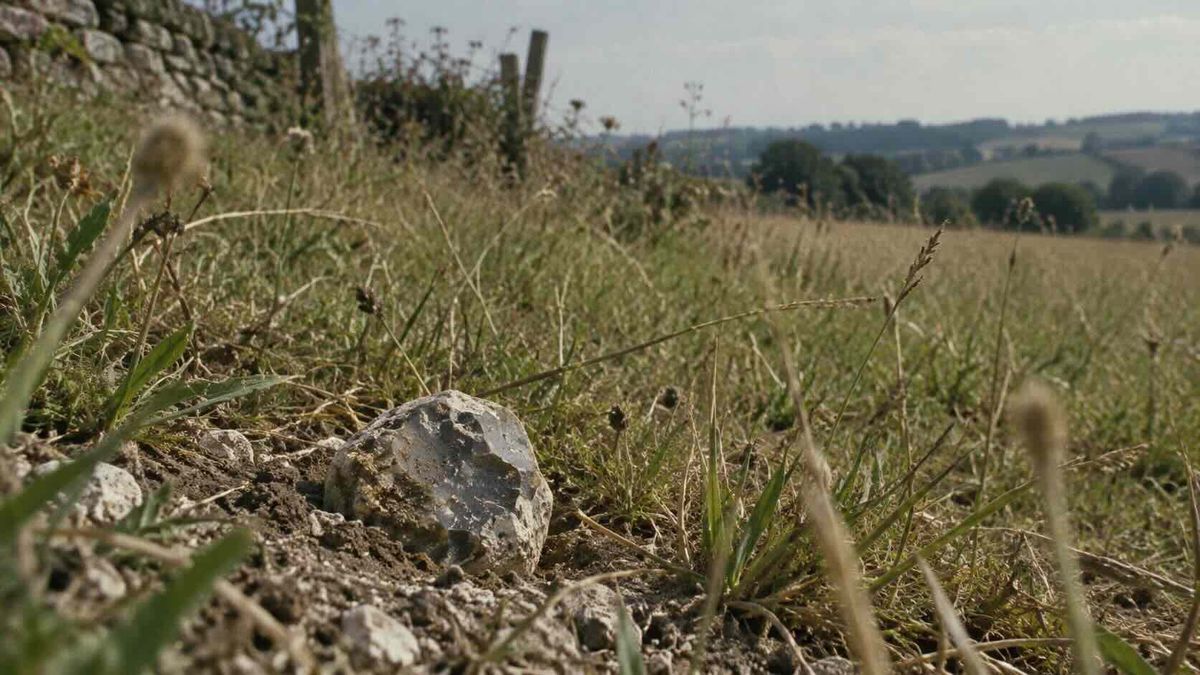
In Omaña, in the mountains of León, a thunderstone was tested by tying a thread around it and putting it in the fire. In Finland, some three thousand kilometres to the north-east, the same thread went round the same kind of stone and was held over a candle. If the thread did not burn, the stone had come from the sky.
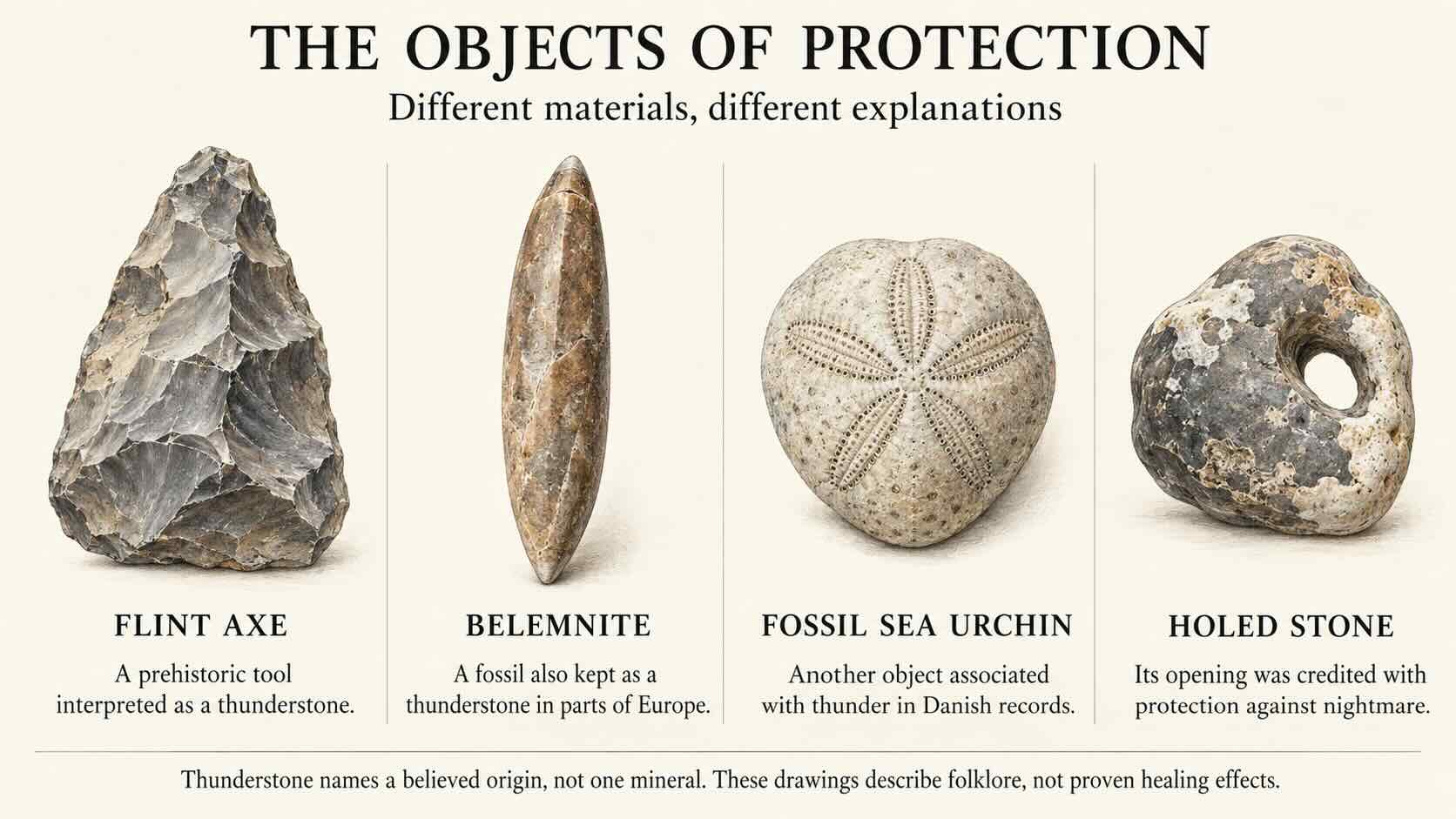
Nobody in either place was testing flint. The thread asked where the object had been, and a thread that survived the flame answered that it had arrived with the lightning and still carried some of it. What the stone was made of did not come into it, and very often it was not flint at all. Christian Blinkenberg showed in 1911 that in Denmark the same protective powers settled on flint axes in Zealand and eastern Jutland, on belemnites in the southern islands and on fossil sea urchins in western Jutland: objects with nothing in common except that a farmer had picked them up in a field after a storm.
This essay follows that habit of asking across as many languages as the sources allow. Wherever flint, or the things taken for flint, have been credited with magical, protective or healing power, the power has nearly always been read as evidence of something else: a god who threw the stone, an elf who shot it, a bolt that had already struck and would not come twice. Where it was not origin it was action, the stone that strikes fire or cuts, or shape, the pebble bored through by water. The substance itself was the last place anyone looked. The crystal-healing pages that sell flint today as a grounding stone have reversed the order, putting the power in the silica and dropping the thunder and the elves, and the second half of this essay is about how that reversal happened and what it kept without knowing it.
There are places where origin and substance cannot be told apart, and they are taken up in their turn: Mesoamerica, where chert and obsidian were lightning made solid; Rome, where Jupiter could be sworn by as a stone; dynastic Egypt, where flint had a symbolic life of its own; the Iroquois and Cherokee, for whom flint is the broken body of a mythical being. Practice also corrects belief. People who scraped a thunderstone into water and drank the powder were treating its matter as medicine, whatever they thought of its provenance.
"All the world's languages" is a goal beyond any single piece of research, and the Editorial Note at the end lists where the sources ran out.
I. What the Words Remember
The words for flint as a material describe what it does to the hand. English flint goes back through Proto-Germanic to an Indo-European root for splitting, with cousins in Greek plínthos, a brick, and Irish slinn, slate. Turkish çakmak, borrowed into Persian as čaḵmāq, into Hindi as चकमक chakmak and into colloquial Tibetan, comes from the verb çak-, to strike. Japanese 火打石 hiuchi-ishi is "the stone that strikes fire", and German Feuerstein and Dutch vuursteen say the same with less ceremony. Spanish pedernal comes from Latin petrīnus, "of stone", and is first recorded in Nebrija's dictionary of 1495. Italian selce derives from silice according to Pianigiani, and Latin silex itself has no secure etymology in the dictionaries consulted for this piece. In none of these languages does the ordinary word for the substance carry a hint of holiness or healing.
The words for the magical object carry the explanation inside them. Danish tordenkile and Swedish torsvigg are the wedge of thunder and of Thor; Finnish ukonvaaja is Ukko's wedge; Lithuanian Perkūnkulkė is the bullet of Perkūnas; Hungarian mennykő is the stone of the sky and istenharagjakő the stone of God's anger. Modern Greek calls the prehistoric axe αστροπελέκι astropeléki, the axe of the lightning. Yoruba has òkúta mànàmáná, stone of the lightning flash; the Ashanti called celts Nyame akuma, the axes of the Sky-God. Chinese has 雷斧 léifǔ, thunder-axe, and Japanese 天狗爪石 tengu no tsume ishi, the claw-stone of the tengu. In Scots the thing is an elf-arrow, in Scottish Gaelic a saighead sìth, in Irish a gae sídhe, a fairy dart. The Finnish series is the tidiest: vaaja, nuoli, taltta, kynsi (wedge, arrow, chisel, nail) name the shape of the artefact, and the prefix ukon- names whose it was.
One word in the whole sample names the stone itself and its power together, and that is Greek pyrítēs, the fire-stone. Pliny, writing in 77 AD, says it is black but burns the fingers when rubbed. The power named is the fire it produces.
II. A Stone That Has Already Fallen
The north and east of Europe are where the pattern is firmest. Blinkenberg's Danish records describe thunderstones built into walls, set under floors and on top of box-beds against lightning and trolls, and placed on the shelves where milk stood so that it would give better cream. The logic against lightning is stated outright by one of his informants: where it has struck, it is not worth its while to come again. The same rule appears in Sweden, and Kristfrid Ganander's Mythologia Fennica of 1789 describes the Finnish ukonvaaja as splinters of hard black stone believed to appear where lightning had struck. The stone protects because it is lightning already spent.
Further east a single motif runs through four languages. In Lithuania the Perkūnkulkė sinks seven fathoms into the ground and rises again after seven years, in some versions nine or thirteen. In Latvia the thunder's bullets come out of the earth seven years after the strike. In Hungary the mennykő surfaces after seven years and whoever finds it is safe from lightning. In Romania the stone goes down nine or seven stânjeni and comes back up one stânjen a year. The same arithmetic turns up in León, where the lightning rises one estado per century and takes seven centuries to reach the surface, and in the Umbria described by Giuseppe Bellucci in 1907, where a single stone protects seven houses around it. The folklorist Nijolė Laurinkienė concludes that the Baltic healing object par excellence was the belemnite, softer and easier to scrape than flint; flint entered the complex as a misread prehistoric tool and as a fire-striker.
That fire-striker leaves two traces in the northern imagination of the gods. In Lithuania lightning was explained as St Peter, the Christian heir to Perkūnas, splitting flint at the gates of heaven to kindle fire. And Johan Fritzner recorded in 1877 that the Sámi thunder-god Horagalles carried his hammer, his bow, and also a piece of flint. The spark and the flash were the same event at two scales.
The oldest document from the eastern Slavic world is hostile. The Kormchaya books, the church's legal compilations, condemn anyone who keeps "thunder arrows" as doing a thing impious and abominable to God, which is the best evidence that people kept them.
What they did with them was mostly medicine for animals, and for people when needed. In Lithuania the powder treated wounds, swellings, sore throats, toothache and snakebite, and the stone was boiled in sweet milk; in Hungary it went into pálinka against fever and boils. Archaeologists can read this practice in the objects. Axes from Großgoltern in Lower Saxony have edges reground to collect powder, a Finnish example from Punkalaidun was scraped down over generations to what the museum describes as a crumb, and an axe from Milicz in Lower Silesia was in therapeutic use until 1941. Someone drinking the dust of a thunder-wedge believed they were swallowing lightning. What they were swallowing was stone, and the hand that scraped it was treating the stone as a drug.
III. Elf-Shot
In the British Isles the projectile comes from below rather than above. At the trial of Katherine Ross, Lady Fowlis, in 1590, conspirators are said to have shot "elf arrow heides" at clay images. Isobel Gowdie of Auldearn confessed in 1662 that the Devil shaped elf-arrows "with his awin hand" and gave them to elf-boys, who finished them "with a sharp thing lyk a paking needle". Robert Kirk, minister of Aberfoyle, wrote in The Secret Commonwealth in 1691 that the weapons of the fairies were "nothing of Iron, but much of Stone, like to yellow soft Flint Spa", and that they wounded with a subtlety like lightning, leaving the skin unbroken. The cure he records was to find the invisible wound with the finger, as if the spirits flowing from a warm human hand were antidote enough.
Kirk notices that the arrows are stone and takes the stone as a sign of who made them. The material is evidence of fairy workmanship, with no virtue of its own. One Scottish text of 1795, cited in the Dictionary of the Scots Language, adds that elf-stones remain as perfect as when they were used in war because flint does not rust. It is the only comment on the substance in the whole British record, and it serves to prove their age.
The concept is older than its identification with flint. The Anglo-Saxon charm Wið færstice, in the Lacnunga collection of the late tenth century, knows the shot of elves, of gods and of witches as the cause of a sudden stabbing pain, but it never mentions a stone: its spears are forged by six smiths and its remedy uses an iron knife. Six centuries separate the invisible projectile from the arrowhead found in a ploughed field and recognised as its material form.
In Ireland, according to Marion Dowd's survey of 2018, fairy darts treated partial paralysis, sore eyes, skin complaints, unexplained lameness, deafness and loss of speech, usually by being dipped in water that the patient then drank. Late-medieval Irish medical manuscripts already speak of urchar millte, the destroying shot.
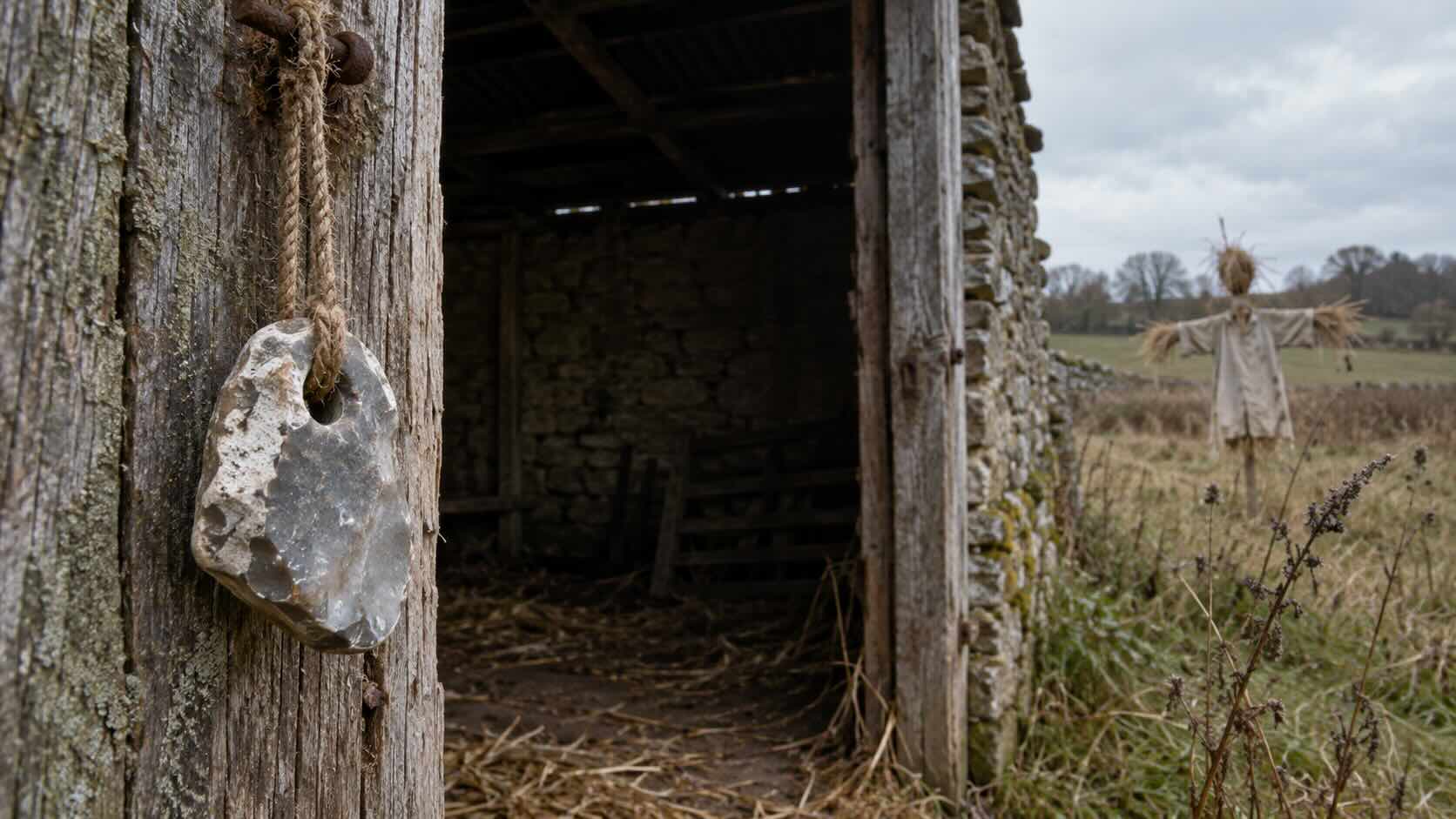
The British material also brings in a place for the power that neither origin nor action covers, and that place is the shape. Holed stones (hag stones, adder stones, Welsh Glain Neidr, German Hühnergötter, the "chicken gods" hung in henhouses) are often flint, but any pebble bored through by water will do, and they have been hung above beds against the nightmare since at least the fifteenth century. In Prussia, the pastor Georg Andreas Helwing complained in 1717 of farmers milking bewitched cows through the hole of a perforated axe. Blinkenberg records a Prussian farmer who, at the approach of a storm, put his finger in the hole of a stone axe, swung it round three times and threw it at the door, acting out the god's throw in his own yard.
The hole does the work, and the stone around it could be anything.
IV. Jupiter Was a Flint
Bellucci found prehistoric points and axes in Umbria, the Marche and the Abruzzo kept in linen chests, anointed with oil and wrapped so that they never touched iron, which would disarm the protective lightning. He describes them as the material part that the bolt carries down to the ground. In León they sat on the windowsill next to the Holy Thursday candle, on the principle that like repels like, and in Asturias, Galicia and León they treated snakebite.
Bellucci also finds a spirit living in the stone, which iron or breakage can drive out. The same logic appears in Malaya, where whoever found a batu lintar would chip it slightly to kill its semangat, its vital essence, and in Melanesia, where R. H. Codrington in 1891 located the power of stones in mana passed on by a ghost or spirit.
The learned root of the category is in Pliny. Following Sotacus, he describes ceraunia shaped like axe-heads, black and red, sought by the Magi because they were found only where lightning had struck; the brontea that falls with thunder and puts out fires; the pyritis that burns the fingers. Pliny's ceraunia is a gem, and its identification with worked flint is the work of Renaissance naturalists, who then took the identification apart. Michele Mercati, in the Metallotheca he wrote around 1593 and which was printed only in 1717, recognised ceraunia as flints chipped all over by another stone in a time when metal was unknown. Jussieu in 1723 and Mahudel in 1730 settled the matter by comparing European axes with American ones. In Spain Benito Feijoo asked, with an irony that has lasted, whether it was not a fantasy that a stone driven down at such speed should arrive "no sólo entera, sino tan tersa, y tan bien formada su cúspide", whole, smooth and with its point so well made.
Rome itself breaks the pattern. The most solemn oath was sworn per Iovem Lapidem, by Jupiter the Stone. According to Livy, the fetial priest struck a pig with a flint taken from the temple of Jupiter Feretrius, saying: Diespiter, strike the Roman people as I strike this pig today. In Polybius's version the man swearing throws the stone and asks to be cast out as it is. Cyril Bailey argued in 1907 that the stone had originally been the god himself. The substance is divine, and it is flint because it is flint, taken from a temple. The modern explanation, that the stone was Jupiter's seat because it gives sparks when struck, would bring the value back to fire, but no ancient text that says so could be found.
Egypt is the hardest case. In Carolyn Graves-Brown's doctoral thesis (UCL, 2010) flint, ds in Egyptian, ds km when black, carries a symbolism of its own, connected with fire, with the goddesses who are the Eye of Ra, with snakes and lions, the northern sky and meteoric iron, a symbolism she describes as anything but static and only loosely related to the technical decline of the material. The fishtail knife psš-kf is offered to the dead in the Pyramid Texts of Unas before the Opening of the Mouth, and Ann Macy Roth has argued that it stands for the knife that cuts the umbilical cord at rebirth. Among the ancient civilisations Egypt is the one where flint as a material had the most independent meaning.
The Bible says nothing about why. Zipporah circumcises her son with a ṣor (Exodus 4:25), and Joshua makes knives of flint for the second circumcision at Gilgal (Joshua 5:2-3). The explanations offered by commentators (an Egyptian precedent, abundance, ritual conservatism) are modern ones. What the text gives is a sacred cut made with an old material and an implicit refusal of metal, which Bellucci found again, three thousand years later, in the Umbrian rule that a thunderstone must not touch iron.
V. Axes of the Sky-God
In West and Central Africa the object is a polished stone axe and not flint at all, and the names collected by M. D. W. Jeffreys in 1974 give the explanation in one word: Bafia yaguébogol, supernatural stones fallen from the sky, born of lightning; Wouté foannoaé, axe of the rain; itané bambarassia, stone of the rainbow; Ashanti Nyame akuma; Yoruba édùn àrá, thunder-axe, the stones kept on the shrines of Ṣàngó. On the Guinea coast these god-stones were kept under the rafters, given offerings of cowries, poultry and kids, anointed with blood or milk, and nobody would perjure himself in their presence, which makes them a close parallel to the Roman oath on Jupiter the Stone. Some communities simply call the object an axe, with no reference to the sky, and for those no power is recorded at all.
Zoroastrian Iran reverses the hierarchy. Among the sixteen fires gathered to consecrate an Atash Behram, the highest grade of fire temple, are a fire taken from a tree struck by lightning and a fire kindled by striking two flints over sandalwood. According to J. J. Modi's account of 1922, the lightning-fire needs ninety rounds of purification and the flint-fire one hundred and forty-four, the highest number of all. Fire made by a human hand from a stone is the hardest to redeem, and fire from heaven the easiest.
China's thunder-stones were never flint. Duan Chengshi in the ninth century lists "stones of the Thunder Lord", axe-shaped and unperforated; Liu Xun at the end of the same century describes black stones like jet found in the fields of Leizhou after a downpour, called "the Thunder Lord's ink", which ring clear when struck; Shen Kuo, in his Mengxi bitanof 1090, notes that the axes are mostly bronze or iron while the wedges are only stone. The black glassy pieces are tektites from the Australasian strewn field, and the wedges are Neolithic tools. Li Shizhen's Bencao gangmu of 1578 lists a thunder-stone, 霹靂碪 pīlìzhēn, among its mineral drugs, but the text of its medical indications could not be retrieved for this essay. In Tibet the thog lcags, the thunder-iron, is most valued when it is gnam lcags, sky-iron, meteoric by definition, so that origin and substance coincide in the one case where the material really did fall. In southern India celts are painted red and treated as Mahādeo; in Malaya the batu lintar are made of clay by jinn, and lightning rises from the earth into the trees.
Japan keeps the two logics in two separate objects. The tengu no tsume ishi catalogued by Kiuchi Sekitei in the Unkonshi(1773-1801) are mostly fossil sharks' teeth, together with stone tools and thunderstones, found in trees, on roofs and inside split rocks, and used as amulets against lightning, evil spirits and disease. The hiuchi-ishi, the real flint of the fire-steel, is valued for its act. Kiribi, sparks struck over the shoulder of someone leaving the house, is recorded by Hiraga Gennai in the 1750s and 1760s and by Santō Kyōden, and it is still practised among kabuki actors, rakugo storytellers, geisha and carpenters in Tokyo. The explanation given is that fire has always been sacred and pure and that malign influences flee from it. The stone is the means of making a new fire that no use has yet touched. The literary precedent is in the Kojiki of 712, where Yamato Takeru escapes a grass fire with the fire-making tools given him by his aunt, Yamato-hime.
VI. The Flesh of Lightning
In Mesoamerica the distinction this essay has been drawing collapses, and the way it collapses is useful. Writing on the cache of eccentric flints at Copán, Ricardo Agurcia, Payson Sheets and Karl Taube state that the material itself had intrinsic spiritual power, because Mesoamericans believed that obsidian and chert were created where lightning struck the ground. Across the region, they note, flakes, blades and cores of both were regarded as products and symbols of lightning and the rain god. The Tz'utujil of Lake Atitlán understand obsidian as materialised lightning. Frank Hamilton Cushing recorded in 1883 that among the Zuni an arrowhead, although shaped by human hands, was thought of as the gift or the flesh of the lightning. Every chip carries the power, so the power sits in the substance, but the reason given is still an origin. Where matter is understood as solid lightning, origin and substance are one thing.
Nahuatl tecpatl adds birth and will. In the account Gerónimo de Mendieta took from Andrés de Olmos, the goddess Citlalicue gave birth in heaven to a flint knife; the frightened gods threw it down to Chicomoztoc, and from it came sixteen hundred gods. The flint knives deposited in the Templo Mayor have faces, with eyes and teeth of shell and obsidian and open, threatening mouths. In the Leyenda de los Soles of 1558, the burning of the goddess Itzpapalotl produces flints of different colours, and the white one, wrapped as a sacred bundle, leads Mixcoatl to war. Among the Classic Maya took', flint, is written as a personified being and carries the face of K'awiil, the lightning-weapon of the rain god Chahk; the pair took' pakal, flint and shield, means war.
In the 1930s the Yucatec Maya of Chan Kom gathered fragments of ancient blades in the bush and took them for missiles thrown by the balam, the guardian spirits, at the evil winds. Robert Redfield and Alfonso Villa Rojas recorded in 1934 that the h-men, the ritual specialist, buried them at the four entrances to the village or set them over the door of a new house. This is the Scottish elf-arrow on the other side of the Atlantic: an ancient artefact read as the ammunition of invisible beings.
In the north-east of the continent flint is a body. In the Mohawk version taken down by J. N. B. Hewitt in 1903, the evil twin Tawĭ'skaron' had flesh that was nothing but flint and a crest of flint on his head; his brother Sapling strikes him with a yellow flint stone or a deer's horn, chips of flint fly off, and the body ends up lying under the western mountains. In the Cherokee story numbered 25 by James Mooney in 1900, Rabbit attacks the sleeping Flint with mallet and wedge and Flint bursts into fragments that scatter everywhere. Both myths explain why flint exists: a dangerous being was broken to pieces. The deer's horn is a knapper's tool, and the myth knows it.
The Navajo Flintway (Béshee), recorded by Father Berard Haile between 1929 and 1931 and published in 1943, is the healing ceremony most closely tied to flint anywhere in the record. Secondary accounts say it treats injuries and accidents, and its myth tells of a young man killed by lightning and revived by Gila Monster, who takes his own body apart and puts it together again. The logic looks homeopathic, the substance that cuts and shatters repairing what has been cut and shattered, but the full text of Haile's book could not be consulted, and that reading should be held loosely.
In Central Australia flint goes back to being a tool. Baldwin Spencer and Francis Gillen recorded in 1899 that the Arrernte circumcised with a sharp flake of flint or a small quartzite knife, and that the lialira knives had been introduced by ancestors in the Dreaming, with no magical handling of the blade itself. The magical substance of the Australian healer, maban, is something else, and flint has no part in it.
VII. Water, Powder, Touch
Set side by side, the documented cures of the human body share very little except the routes by which the stone reached it. The stone could be left in water that the patient then drank, it could be scraped into powder and swallowed, or it could be laid on, rubbed, tied or held.
Water is the commonest route and the most widely spread. Irish fairy darts were dipped and the water given to drink; in Cornwall thunderstones were boiled and the water kept as a general remedy; in Romania the water in which the stone had been washed treated the junghiuri, stabbing pains in the side; in Malaya the batu lintar went into water-based remedies of unspecified use. Powder belongs mostly to the north and east, from Lower Saxony to Finland and Lithuania, and it is the one route that leaves marks archaeologists can read on the objects themselves. Touch covers everything else. In Germany, according to Blinkenberg, the sick were stroked on the painful place with a Donnerkeil; in Salamanca thunderstones were rubbed on rheumatic joints; in Sweden an axe hung round a child's neck against fever; in Scotland jade axes were worn against kidney complaints, which takes the cure as far from flint as it can go while keeping the shape. In 1628 a Scottish healer named Stein Maltman was accused of rubbing his patients with elf-shot.
The list of complaints is long, and a few recur in places that had no contact with one another. Childbirth first. In 1684 a clergyman named John Keogh recorded a fairy dart used in labour in County Roscommon; stone axes were handed to women in labour in Lower Saxony, Hesse, Scotland, Sweden and the Czech lands; in the Bierzo and Galicia a thunderstone tied to the left leg eased the birth, while tied to the left arm it held it back. Then snakebite, treated with the stone in Lithuania and in Asturias, Galicia and León, at opposite ends of the continent. Then the skin: boils, eruptions and swellings in Finland, Latvia, Hungary and Lithuania, and, in a Japanese attestation reported by Maria Leach in 1972, boils and ulcers. Burma adds a single surprising case, the thunder-celt used to cure and prevent appendicitis, known only through a secondary source.
What these complaints have in common is that they arrive suddenly, open the body, or both. A stabbing pain in the side, a bite, a boil that breaks, a wound, a birth: these are the events folk medicine attributed to a blow from outside, and the Anglo-Saxon færstice, the sudden stitch caused by the shot of elves, gives the logic its oldest name. A stone that had itself arrived as a blow, out of the sky or from a fairy's bow, was the obvious thing to set against them. None of the sources states this as a rule, and it is Hwael Mag's reading of them, but it fits the record better than any property of silica could, and Ireland comes close to saying it: Dowd, summarising the evidence, writes that the same elf-stones that caused the illness were used to cure it. It also helps that most of these conditions pass on their own. A swelling goes down, a stitch in the side stops, a boil breaks and heals, and a stone applied in the meantime gets the credit. The thunder-wedge powder of the Baltic is looser than the Irish darts, a panacea that did not need a supernatural disease to justify it, and this is where practice slides furthest towards treating the stone as a drug.
The Navajo Flintway belongs to the same family from the other side of the world, a body broken by lightning and put back together. In Cherokee practice, again according to Leach, a patient might be scratched for medicine with an invocation to Flint. Only Egypt, Israel and the Arrernte put flint into the body in the most literal way, as the blade that circumcises or, if Roth is right, cuts the cord, and there the stone heals nothing: it marks a passage.
Some cures that circulate widely could not be confirmed. No primary source was found for flint used to cut away warts or applied specifically to diseased eyes.
VIII. The Rules of the Stone
The stone did not work on its own. Scattered through the records are the conditions under which it worked, and read together they describe the cure as a procedure in which the object was one part.
The first condition was that the stone be what it claimed to be. The thread in Omaña and the candle in Finland were tests of provenance, and so, in its slower way, was the seven-year rise through the soil: a stone found on the surface of a field after a storm had passed an examination before anyone picked it up. A thunderstone that had been through the fire with its thread intact had a certificate.
The second was the ban on iron. In Umbria the axes were wrapped so that they never touched it; in the Abruzzo, as Gennaro Finamore recorded at the end of the nineteenth century (read here through a secondary source), the stone lost its virtue everywhere if it touched iron. Kirk's fairies carried nothing of iron, and the elf-arrow mounted in silver, worn in Scotland from the late seventeenth century, keeps the rule in the setting. Iron is the metal that replaced the stone, and it is also the metal the Anglo-Saxon charm used to cut the elf's spear out. The two materials were understood as enemies, and the old one had to be kept away from the new.
The third was number and sequence. The Irish recipes that Dowd follows from late-medieval manuscripts to a case from around 2007 draw water from three streams at a boundary, give it in three draughts, pass the dart three times over and under the beast. The Prussian farmer swung his axe round three times before he threw it. At Coragh, in County Cavan, a Neolithic flint scraper went into the pail for the first three milkings after a cow had calved. The stone was effective inside a count.
The fourth was the hand. Kirk's cure begins with a finger searching the skin for a wound that cannot be seen; Stein Maltman was accused of rubbing; the h-men of Chan Kom chose the four entrances where the blades went into the ground; at San Vittorino in the Abruzzo the stone was lent from house to house for children's illnesses, and lending implies someone who knew how it was to be used. The Yucatec blades, the Irish darts and the Umbrian axes were all handled by people whose knowledge was part of the remedy.
The last condition was that the stone could be used up. The axe from Punkalaidun was scraped over generations to a crumb; the edges at Großgoltern were reground to yield powder; the Milicz axe went on being scraped until 1941. A cure that consumes its own instrument treats that instrument as a quantity, and the people who did the scraping knew that one day there would be none left. This is the point where the thunder-wedge comes closest to a modern pharmacy, and it was reached by people who were sure the thing had fallen from the sky.
IX. Byre, Churn and Seed-Sack
The patient was more often a cow than a person. In every European record the bulk of the cures concerns animals and the household economy, and the evidence, gathered most fully in Tomasz Kurasiński's survey of 2021, is dense enough to map.
Cattle come first, and in Scotland and Ireland they suffered from the same illness as people. Thomas Pennant wrote in 1771 that an elf-shot cow was to be touched with an elf-shot or made to drink the water in which one had been dipped; the Scottish dictionaries define the cattle disease, more prosaically, as a swelling of the first stomach after a feed of clover and grass. Irish recipes add salt, lady's mantle and a silver coin to the water from the three streams, or boil the dart with soot, earth, salt and meal.
Milk is where the stone did most of its European work. In Denmark, as Blinkenberg records, it lay on the milk-shelves for better cream and on the churn for good butter, so often that one local name for it was butter-luck. In Germany, Bohemia, Silesia and Hungary it was rubbed on the inflamed udders of cows and goats, an inflammation explained as the work of witches milking the animal by night. In Moselle and in Asturias, Huesca and León the stone was soaked in milk or oiled first. In Poland, according to Biegeleisen in 1929, cows were milked through the hole of a stone axe so that they would give plenty of good milk; in Croatia a sick animal's urine was passed through the same hole while charms were said. In Asturias holed stones hung in the cowshed to bring female calves.
Horses suffered at night. In Denmark and Sweden a thunderstone was placed over the horses in the stable to keep away the nightmare, and in Dorset the Pitt Rivers Museum holds a holed stone, collected in 1880 or 1881, which was hung against witches who rode horses in the dark: when an animal was found sweating and exhausted in the morning, it had been ridden. In Lithuania a stone under the manger freed horses ridden by witches or devils. Sergei Maksimov described in 1903 the Russian custom of hanging "chicken gods and horse gods" over stalls and perches. At Vijlen in Dutch Limburg a blacksmith pressed a Neolithic adze marked with a cross against horses' swollen gums, and at Fresno de la Vega in León the mane hair cut at shearing was kept under a thunderstone in a niche in the wall, to give the animals strength.
The smaller animals have shorter entries. In Hesse stone axes went into the piglets' trough so that they would breed better; in the French uplands, according to Cartailhac in 1878, axes were boiled in water meant for sick sheep; in Brittany they were put in hens' nests for better brooding. The Russian kurinyy bog, the chicken god, was a holed stone hung by or over the feeder in the henhouse so that the hens slept safely and were not frightened or pressed by the kikimora or the house-spirit. No evidence was found for thunderstones in beehives, a use often repeated in the secondary literature.
Then the grain, and the moments when food changes state. In Sweden the stone lay in the granary against rats, in a sack of barley near Uppsala so that the grain would never run out, in the flour in Värmland for the same reason, and in the brewing vat so that trolls could not spoil the beer. In Silesia, Sweden and Finland it was put in the seed grain at sowing, and at Lake Kenozero in northern Russia, according to Kharuzin in 1894, with the turnip seed; elsewhere it was buried in fields against hail and fire and hung on sick fruit trees. In Poland a thunderstone in the kneading trough made the dough rise. In Brittany prehistoric stones were thrown into wells to keep the water pure and lasting, and in Côtes-d'Armor the water of such a well protected cattle.
The churn, the trough, the vat, the seed-sack and the pail after calving are the points in the household where one thing becomes another, milk into butter, flour into bread, seed into crop, and they are exactly where witches and trolls were thought to steal the profit. Maksimov adds a detail that settles what the holed stone was for: when no stone was to hand, the neck of a broken jug would do for the hens.
X. The Mare, the Changeling and the Evil Eye
The afflictions of the mind that the old stones answered were nearly all attacks from outside, and nearly all of them came at night.
The best documented is the nightmare in its literal sense, the Mare, the German Alp or Drude, the hag who sits on the sleeper's chest. Jacob and Wilhelm Grimm's dictionary, in the fascicle of 1858, defines the Drudenstein as a small stone rounded by water with a hole made by nature: it is hung in bedrooms, on cradles and in horses' stables against the pressure of the nightmare, and against the Drude, whose magic these stones make powerless. German sources note that such stones are often flint nodules. The English hag stone hung over the bed served the same purpose from at least the fifteenth century. The Pitt Rivers stone from Dorset was nailed to a carter's cottage door to keep away witches, and the museum, citing modern research, connects hag-riding with what is now called sleep paralysis. The stone guards the threshold of sleep, and again the work is done by the hole.
Children were the most exposed. In Germany, Blinkenberg writes, the thunderstone was put in the cradle with little children to protect them; in Denmark it protected the unchristened child against being changed, that is, taken by the trolls and replaced by one of their own. In Aberdeenshire a little silver heart, the witch-brooch, was pinned to a baby's underclothes at its first dressing, and W. W. Skeat suggested in 1912 that it descended from an elf-arrow mounted in silver.
The Irish fairy stroke is the clearest case of a psychic illness with a stone cure. Following Seán Ó Súilleabháin's handbook of 1942, Dowd lists among the effects of elf-shot fainting, loss of speech, paralysis, and blindness after a glimpse of the fairy world; in 1887 James Mooney recorded the cure, the same dart put in a tumbler of water that the patient drank. Blinkenberg goes further in one passage, writing that the thunderstone was used to cure insanity, as part of the same logic that made people swear their gravest oaths on it and hurl it against the door to imitate the stroke. The passage does not say where or how, and it is reported here with that reservation.
The evil eye belongs to the south. Blinkenberg found thunderstones in Italy used very commonly as amulets against the injurious influence of the evil eye. In the Abruzzo, according to Finamore, the stone was set in gold or silver at Pescina and worn by children with other amulets against malocchio e fatture, the evil eye and spells; at Archi it worked against witches' charms. The Japanese kiribi, the sparks struck over the shoulder at the door, belongs to the same family of defences: what it drives off is jaki, malign influence, before it can attach itself to the person leaving.
The stone carries an event.
Thunderstones and elf-arrows were understood through the forces believed to have sent them. Their material could vary while their attributed origin remained decisive.
Danish and Swedish accounts describe stones kept against lightning because a place already struck was believed to be safe from another strike. Prehistoric tools and fossils could occupy the same protective role.
A found object is retained as evidence of a past strike.
What could not be found is as telling as what was. No source was located for flint or thunderstones used against epilepsy, against the Russian ispug or the Latin American susto, the illnesses of fright, against melancholy, or against possession.
Nothing in the record treats a mood, a temperament or a weakness of character.
XI. Liver, Courage, Aura
The modern lists cover the same territories, body, mind and something beyond both, and fill them with different things. They come from vendors' and teachers' pages in English, French, German, Czech and Polish, consulted in 2026, and they are recorded here as claims.
The body has moved inside. The French lithothérapie pages, copied word for word into Spanish and English, give flint the kidneys and kidney stones, the circulation, the liver, calcium deposits in joints and arteries, the lungs, skin lesions and adolescent acne, digestion and headaches. A German page last revised in June 2026 offers detoxification, mucous membranes, skin, lungs and intestines, against both diarrhoea and constipation; a forum post of 2006, the oldest dated German text found, already had the same list. A Czech site adds the immune system, bones, teeth and regeneration; Heilsteinwiki, in 2019, sight and hearing. The Belarusian silicon water of the late 1970s brought tumours, cholesterol, infection and the removal of radioactive caesium and strontium, and the Polish striped flint picked up blood sugar, cholesterol and immunity on its way from jeweller's bench to astrology site. The organs are slow ones, liver, kidneys, gut and bones, the complaints are chronic, and no one is blamed for any of them. The sudden blow from outside, which organised the whole of the older medicine, has gone from the list.
The mind has become character. The same French pages promise courage, strength, enterprise, conviction, decisiveness, help with stress and with an inferiority complex, and recommend flint, with a precision that is almost touching, to teachers, doctors, soldiers, lawyers and politicians. The German Heilsteinwiki of 2019 offers composure and inner calm, self-confidence and initiative, team spirit, and help for introverts to come out of themselves; heilstein.de gives flint the single keyword Verständigung, communication, so that people stop talking past each other. Czech pages list stability, endurance and the handling of stress; the Polish jewel is the stone of optimism; a British course provider says flint reduces anxiety. Where the old stones guarded a sleeper against a visitor, these address a personality that needs improving, and the virtues are the ones an office would ask for.
One thing has survived intact. The French family still lists nightmares among the complaints that flint relieves, the only point at which a modern claim matches a documented old use, and it reached the vendors with no hag, no mare and no hole.
Beyond the mind lies energy, and here the vocabulary is the newest and the claims the most uniform. Flint grounds: it anchors the body to the earth, and its chakra is the root or the Earth Star below the feet, although other pages give it the solar plexus, the third eye or all seven. It cuts: English pages promise to sever karmic ties and the cords that bind a person to former partners, French ones the toxic attachments left by trauma. It shields: it protects the aura from negative energy and, in several versions, from electromagnetic fields. It joins the etheric body to the physical one, opens past-life memory and ancestral clearing, sends thoughts, and, in the French text, allows communication with nature spirits and fairies, which brings the fairies back by the side door as friends. Two pages give a vibration number, seven and eight, and none in any language gives a frequency in hertz. The care of the stone itself has its own ritual: cleanse it monthly under running water, recharge it under the full moon or on a cluster of quartz.
Read against the older record, the energy vocabulary is less new than it sounds. Shielding the aura and cutting cords imagine the person as something open to attack from outside, by negative energy or by attachments to others, which is how the hag stone and the elf-arrow imagined the sleeper and the cow. The assailant is still there, renamed as a force with no face, and the stone still stands between it and the body. The modern pages show no awareness of the parallel, and what has gone from it is everything that made the old defence specific: who was attacking, where the stone came from, what it had already done.
XII. Belarusian Water, Polish Silver, English Chakras
The relocation of power into the stone came by at least three routes, and only one of them is the one people think of.
The first is Soviet and biochemical. At the end of the 1970s Anatoly Malyarchikov, described by the Belarusian state daily SB as a lead designer at the Institute of Heat and Mass Transfer of the Belarusian Academy of Sciences, began promoting kremnievaya voda, flint water or silicon water: a piece of flint left in drinking water. The chemist Dmitry Grinshpan of the Belarusian State University replied that presumed hypotheses are not evidence and that the only measurable effect is a slight increase in alkalinity.
The second is Polish and comes from a jeweller's bench. Cezary Łutowicz began setting the striped flint of Krzemionki in silver in 1972. The phrase kamień optymizmu, the stone of optimism, arose, according to the Polish press, from the intuition of the women who wore it, and it became the brand of the town of Sandomierz, with a festival of that name first held on 2 September 2011. The medical properties arrived later, on astrology websites, and they copy the Russian list almost word for word.
The third is Anglophone crystal healing, whose vocabulary of etheric bodies and thought transference follows the idiom of the 1990s. Chakras and star signs vary from page to page (Scorpio, Gemini, Aries, Sagittarius, Taurus, every sign except Pisces), which looks less like a tradition than like each publisher deciding for itself, and the crystal teacher Hibiscus Moon herself dismisses bare vibration numbers by asking what the seven is supposed to be seven of. When flint first appeared in a crystal-healing handbook remains undated: the books that probably set the vocabulary, Melody's Love Is in the Earth (1991) and the works of Judy Hall, could not be read for this essay.
In all three routes the power has become a property of the substance, and the substance has no origin. On none of the crystal-healing pages examined do thunderstones or elf-arrows appear. The one exception is the French lithothérapie family, where scraps survive in a strange order: flint protects the house from lightning, the Vikings blessed family knives with beer and melted butter, the Irish used blades against the fairies. The beer and butter come from the Scandinavian custom of honouring thunder-axes as household gods, transferred here from a Neolithic axe to a flint knife. The holed stones and arrowhead pendants of modern witchcraft keep much more of their old lore, and they keep it, as before, in the hole and the shape. Science adds little that is new: flint is microcrystalline quartz, and the one controlled test of what people feel when holding crystals, presented by Christopher French and a colleague in 2001, found no difference between real quartz and glass fakes. Japan stays outside the modern model too. Kiribi keeps the logic of the act, and the power-stone trade sells flint beside rock crystal and amethyst without inventing properties for it.
The old flint was a mark left by a being or an event, and its strength was measured by the story it carried, a story that could be checked with a thread that did not burn or a stone rising through the soil for seven years. The modern flint carries no story, which is why it can be sold by weight and filed by chakra. The break was never clean. The Finnish families who scraped an ukonvaaja down to its last crumb were already using matter as medicine, and Pliny already kept the sky-fallen gem apart from the pyrite that burns the fingers. But the thread in Omaña, the candle in Finland and the fragment of Rabbit's victim in a Cherokee field belong to a world that asked a stone where it had been, and the card in the vendor's box asks only what it is good for.
Last revised: October 2026