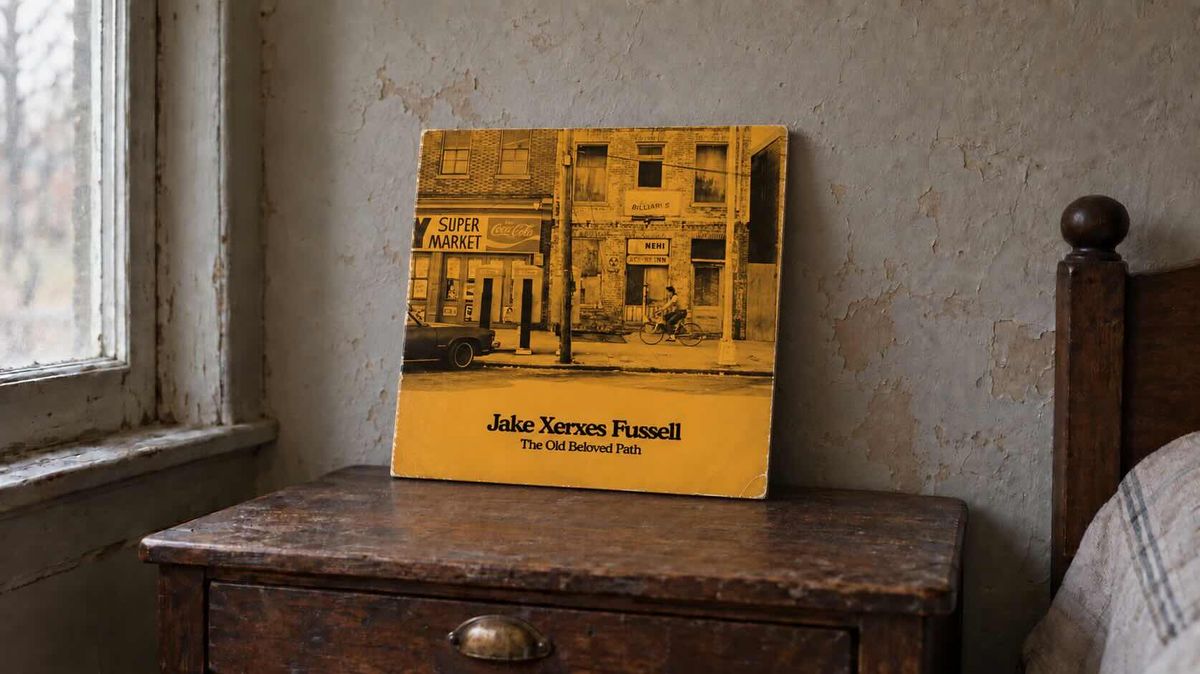
Some singers carry other people's songs the way a postman carries letters: they know the weight, and they don't open them in front of anyone. Fussell is one, six records in.
Raised in Georgia among people documenting traditional songs, stories and crafts, Fussell has made a recording life largely from material that reached him through other hands. A verse from one singer, a verse from another, a bit of handling, then pass it on. That's how songs have always travelled, a little bent at every stop. That handling is where his own voice enters.
The room empties out here. Less of the fog from the last two records. Recorded by Alli Rogers at Betty's in Chapel Hill, with Ben Whiteley producing and later mixing in Toronto, the album keeps the musicians close enough that you hear the space between notes, sometimes the wood itself. The guitar sits in the middle, picked with no hurry at all, low strings thudding like a boot on floorboards, and over it that worn baritone that never raises its voice, even when it could. The only thing he wrote here is “No 1”, the opener, an instrumental that circles itself before deciding to come in. Like someone who knocks, and waits.
GROUND SECTION /
01SELECT A LAYER
A railway song crosses the Atlantic and returns with other words.
John Lomax recorded “Rock Island Line” in an Arkansas prison
in 1934. Lead Belly reshaped it; Lonnie Donegan's version
helped carry it into British skiffle. Fussell names Donegan's
recording as his way back into the song. Unable to make its
verses work for him, he joined the refrain to an old English
nursery rhyme. That particular splice is his own.
A dance-song survives in a slower setting.
“Rosin Some” draws on the song associated with Gid Tanner
and the Skillet Lickers as “Sal, Let Me Chaw Your Rosin Some”.
Rosin belongs to the fiddle bow; the older title places the
words close to the instrument and the dance. Here those
fragments enter a quieter arrangement, with space to hear
them apart from the momentum of a hoedown.
Napoleon's history is fitted to the length of a pull.
“Boney” is a short-drag shanty, used to coordinate brief
hauls aboard ship. Its Napoleon travels through verses
that change between singers and collections: battles,
Moscow, exile at Saint Helena. The song's working rhythm
gave these pieces of history a practical use. It circulated
on English and American ships and remained a work song
among Caribbean fishermen into the twentieth century.
The sailor comes home to a life that continued without him.
“Early Early in the Spring” belongs to a ballad family
found on both sides of the Atlantic and preserved in
British broadside versions. A sailor leaves with a promise
of fidelity and returns to find his sweetheart married.
Versions alter the circumstances of the separation;
the arrival home brings the same discovery. Fussell's
performance carries that old account of absence into
a small ensemble.
The pest is given a speaking part.
The boll weevil entered the United States from Mexico
in the late nineteenth century and spread through the
cotton-growing South. Songs made the agricultural disaster
into a conversation: the farmer questions the insect,
which keeps looking for a home. The repertoire circulated
through many singers, including Lead Belly and Charley
Patton. Their recordings establish part of the song's
history; they do not, by themselves, establish the sources
of every verse Fussell sings.
WHAT REMAINS
These layers describe the songs' wider histories. Fussell
explicitly identifies the Donegan recording and nursery-rhyme
splice behind “Rock Island Line”; the other entries trace
repertoire families without claiming a complete list of his
source recordings.
“Rock Island Line”, the old railroad song Lead Belly carried and Lonnie Donegan turned into skiffle, slows the train nearly to a stop: upright bass at carriage pace, a harmonica far off, a whistle past the hill. The movement is steady enough to settle into, though the voice keeps finding small turns inside it. Fussell lets the familiar refrain take its time.
“Boney”, a sailors' hauling song about Napoleon that never agrees with itself, catches more light. Guitar glinting, a fiddle leaning in and backing off, piano keeping song like a hand on the rail.
He sings it asking nothing of anyone.
“Boll Weevil” laughs, or nearly. Light drums and a country-dance sway give the weevil's repeated request for a home a peculiar ease. Fussell scarcely pushes it. Heard now, that request begins to sound like anyone who arrived somewhere and was told there wasn't room. The arrangement keeps moving while the question stays unanswered.
“Of All the Beast-es in the World” closes it, not even two minutes. Guitar barely touched in a lullaby with the door left ajar.
What gets me, in the end, is the patience. Fussell walks a path worn down by a great many feet, feels every one of them, and adds his step without claiming he cut the trail.