Richard Bundy & Anna Phoebe :: From the Edge
Post-classical, field recordings, strings and coastal acoustics
Stone, natural reverberations, and salt-laden air become part of the music itself. From the Edgelistens closely to Dover, tracing its slow and weathered breath.
From the Edge is one of those records that feel more like a place than a collection of tracks. Born out of the Dover Unlocked project of the Kent-based composers Richard Bundy and Anna Phoebe, the album uses the historic spaces of Dover, an English coastal town suspended between sea, war and memory, as an integral part of the composition itself. Not backdrop. Matter. Chapels, fortifications, tunnels and underground staircases, the Grand Shaft spiralling a hundred and forty feet down through the chalk of the cliffs, St Edmund's Chapel, Fort Burgoyne, enter the sound with their ambient noise, their natural reverbs, their air, their distance. The music seems to rise out of the stones and the coastal wind.
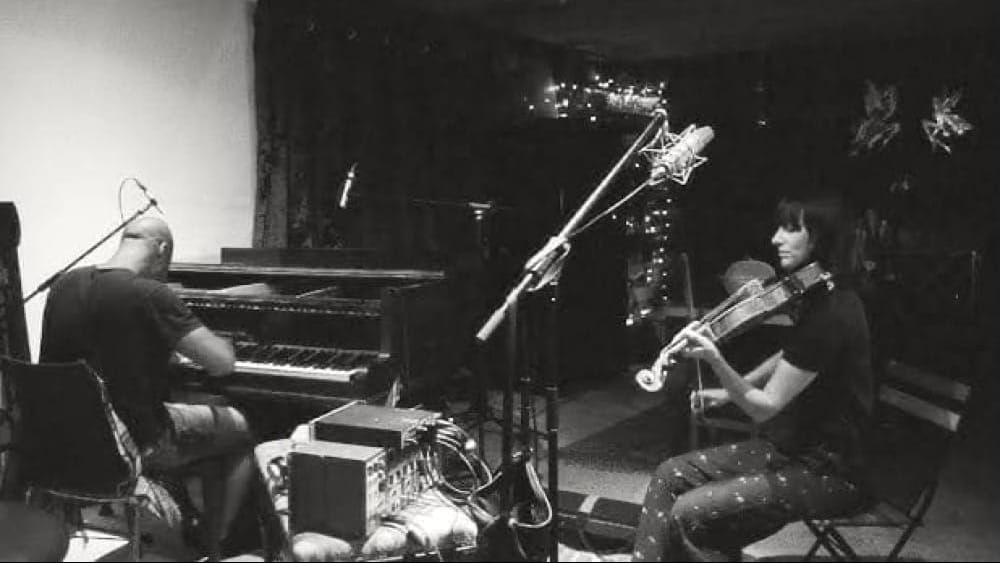
It begins almost as a threshold. "The Immersion" is a single long movement, close to twenty-three minutes, the whole of Side 1, and it opens in near-silence: soft washes of acoustic and electronic sound, Anna Phoebe's violin threading in over a low hum, the outside world already bleeding through, distant traffic, the grain of a room, before the ensemble gathers. From there the palette opens wide.
Richard Bundy's piano builds a modern neo-classical base that's never too sentimental; Phoebe's violin crosses the pieces like a physical presence, an emotional current binding dusty electronic beats, drones, choral voices and field recordings. And running beneath it all, the Sacconi Quartet, recorded inside St Edmund's Chapel itself, lends the strings a rhythmic intensity that keeps tipping the record from stillness into propulsion, the chapel's own acoustics folded into the sound.
There's a tension rarely found in Clay Pipe Music releases, a label that usually lets rural landscapes, memories and childhood nostalgias do the talking. In From the Edge, instead, the coastal landscape addresses the present and the generations to come directly, expressing above all its own material, mineral dimension. It is, avowedly, a record that reimagines and quietly subverts the accepted narrative of Dover as a border town.
Not the anxious threshold of the frontier. The stone that was there before the border, and will be there after it.
In the closing minutes of "The Immersion" a jazz-inflected drumming surfaces, recalling certain cinematic drifts of Ninja Tune, while the second movement, "Unspiralling the Rock", moves through prog-rock, soundtrack classicism and sudden openings into an almost hauntologically danceable 4/4. It's here that you catch the principle holding the whole record together: the electronics, like every instrument involved, live off a technical command that is never in the service of the musician nor the listener. It serves the places themselves. Near-motionless, meditative passages tip over into rhythmic explosions; the strings grow more intense; a bass moves through dub, jazz and even funk; the electronics wear themselves down to a grain; the distant A20 bleeds in until its noise turns to pulse. You get the impression of a work out of scale with the usual contemporary ambient release: an ambitious, deeply physical record, able to withdraw from both decorative aesthetics and mere conceptual exercise.
Some passages work more as spatial experience than as self-standing compositions. But this is probably the project's real point. Dover surfaces as an intermittent presence: not a setting, but an acoustic organism made of echo, air currents and sedimented memory.