Peter Weir :: Picnic at Hanging Rock
Folk horror, colonial order, liminal time and landscape as threshold

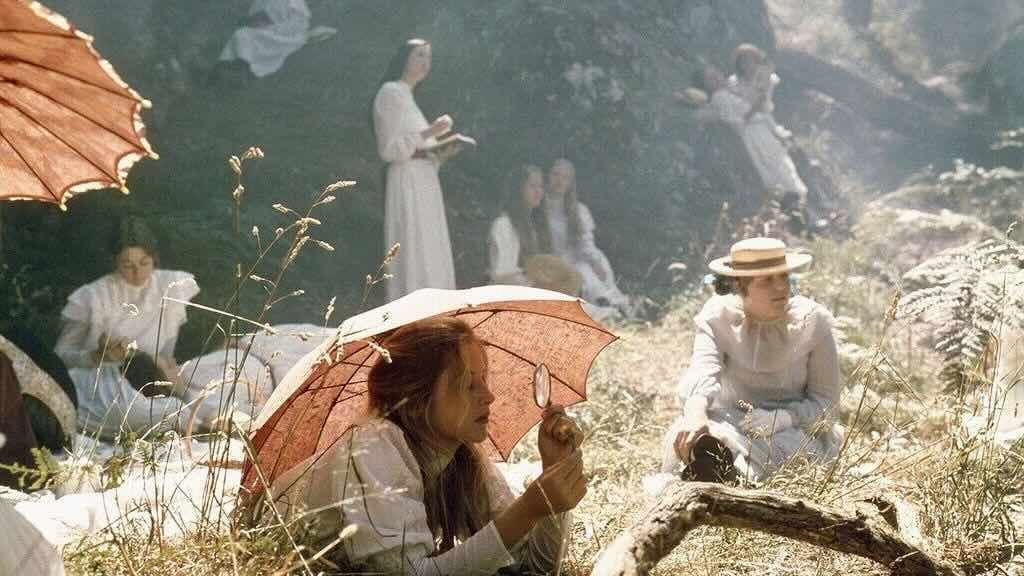
Set in colonial Australia at the beginning of the twentieth century, the film begins with something deceptively simple — a school picnic, a brief excursion — before gradually fracturing into uncertainty. A group of girls disappear among the rocks of Hanging Rock, and what follows is not an investigation but a slow disintegration: of order, rationality, and meaning itself.
The power of the film lies precisely in this refusal. There is no explanation, no resolution, not even a conventional investigative impulse.
The mystery must remain intact.
In this sense, Picnic at Hanging Rock becomes a radical critique of positivist illusion: not everything can be understood, and the desire to explain may itself become a form of anxiety.
Time itself begins to lose consistency throughout the film. Watches stop, but more profoundly, linear time starts to collapse. Past, present and something far older seem to overlap, as though Hanging Rock were a point of interference — a threshold where time no longer flows but slowly accumulates in layers. The stopped watches are one of the film's explicit disturbances, something contemporary criticism already singled out on its first international circulation.
Nature, too, is never treated as mere background. The rock dominates, watches, absorbs. It does not need intention in order to feel present. It exists as something irreducible, something exceeding human measure. In this reversal, humanity is no longer central, but fragile — destined to be overtaken by what it cannot control.
Socially, the film places two incompatible worlds in tension. On one side stands Appleyard College, with its discipline, moral rigidity and obsessive need for order. On the other lies the Australian landscape: opaque, indifferent, untamed.
The disappearance can therefore be read as a symbolic fracture — the failure of colonial order before a territory that refuses domestication. The BFI has similarly located the film's folk-horror pressure in white colonial society's estrangement from the Australian landscape and its Indigenous history.
The girls themselves exist in a liminal state, suspended between childhood and adulthood. Their ascent towards the rock gradually takes on the shape of a passage or initiation. Not quite an escape, but a dissolution: of identity, role and social form. Miranda, especially, feels less like a character than an apparition — an ideal image constantly withdrawing from definition.
In this sense, Hanging Rock becomes a threshold space. Noon light, sleep, silence: everything contributes to the construction of a ritual atmosphere. What unfolds is not tragedy in the classical sense, but a transformation that escapes language itself. The girls do not simply “vanish”; they pass elsewhere, into a dimension the film only suggests through absence.
The soundtrack remains one of the reasons the film continues to linger in memory. Gheorghe Zamfir’s panpipes, particularly “Doïna: Lui Petru Unc”, move across images of the rock and the schoolgirls with an archaic, drifting quality that deepens their unreality. Peter Weir himself spoke of the music's “pagan” quality and of the way it opposed European ideas of time, culture and civilisation. Bruce Smeaton's score occupies the film alongside those Romanian pieces.
A small mechanical failure becomes the first sign that ordinary chronological time no longer governs the rock.
The landscape does not need intention to feel present; it exceeds the human scale imposed on it by the college and its rules.
Zamfir’s drifting sound moves across the rock and the girls, deepening the sense that another order of time has entered the image.
Picnic at Hanging Rock ultimately refuses the conventions of cinematic storytelling. What remains is not the need to ask what happened, but the necessity of accepting the film on its own terms. More than an answer, it leaves behind an open wound in thought.