Gareth Dickson :: Orwell Court
Ambient folk, fingerstyle guitar, reverb and faded post-punk memory

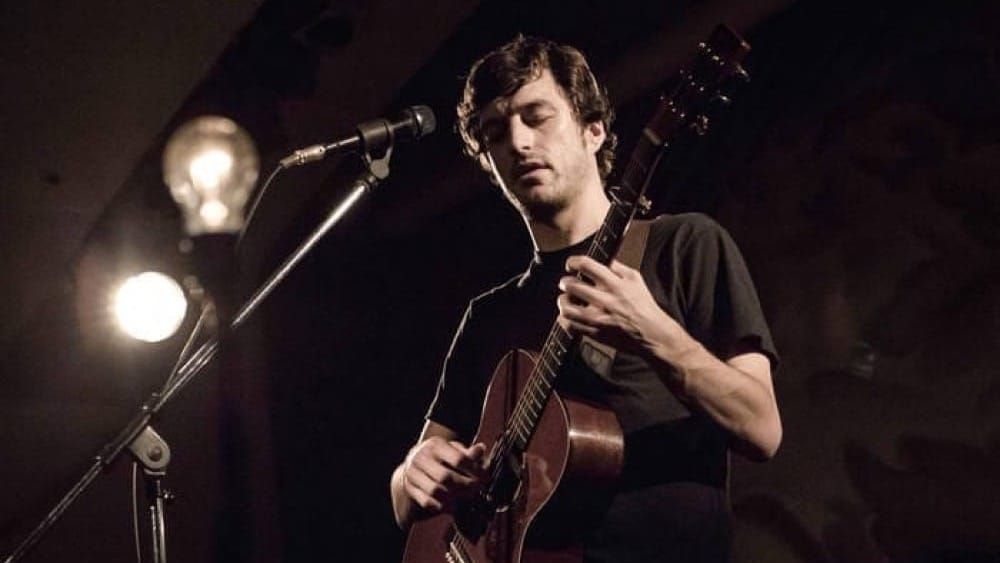
A pale, nocturnal folk record that feels unearthed from old photographs left too long in the light.
Gareth Dickson comes from inside the tradition he's usually measured against. For a decade he has been the constant guitarist in Vashti Bunyan's touring band, and the fingerpicking of Orwell Court carries that lineage — Bunyan, Nick Drake, Leonard Cohen, the slow inward pull of pastoral folk — in its bones. What complicates the picture is where the record lives: not on a folk imprint but on 12k, Taylor Deupree's label of ambient and microsound. That address is the whole argument.
Orwell Court is the Drake–Bunyan lineage run through reverb and delay until it begins to dissolve — folk pushed toward the blurred edges of hauntology.
Not a revival, because Dickson never quotes the tradition as a relic; he lets it fade like an over-exposed print.
Built around the warm, woody resonance of an all-mahogany acoustic and shaped with little more than reverb and delay, the songs share a single haze without collapsing into one another. "Two Halfs" turns on a handful of repeated figures and a vocal held at the far edge of audibility, the whole thing seeming to recede even as it plays. "The Big Lie" is slower and minor, its arpeggios luminous against faint harmonic shadows that pass through the centre of the song and out again. "Snag With The Language" begins withdrawn and opens by degrees — soft percussion, a liquid keyboard — the closest the record comes to warmth of colour. "The Hinge Of The Year" is its most comforting few minutes, a gentle pattern and an understated lyric that recall early Sun Kil Moon without leaning on the resemblance, while "Red Road" lets a clearer melody through and "The Solid World" drifts furthest from folk of any kind, into low drones and stretched guitar tones that could belong to Dickson's 12k labelmates as easily as to him.
It's the closing cover that makes the method plain. Dickson takes Joy Division's "Atmosphere" — one of the most guarded songs in the post-punk canon — and treats it exactly as he treats his own writing: the original's marble tension gives way to softened guitar, a little reverberation and a voice that barely clears a whisper. He doesn't so much reinterpret the song as let it fade to the same pale grain as everything around it, and that is the record's real thesis in miniature: any music — folk or post-punk, monument or lullaby — can be reduced to breath and the memory of itself.
Throughout, Dickson refuses weight and ornament. The arrangements are sparse and patient, kept close to the physical fact of the playing — careful hands on the strings, melodies that never raise their voice — and the record earns its quiet not by being small, but by knowing exactly how little to do.