David Gladwell :: Requiem for a Village
Rural England, memory, burial and the maintenance of a disappearing village

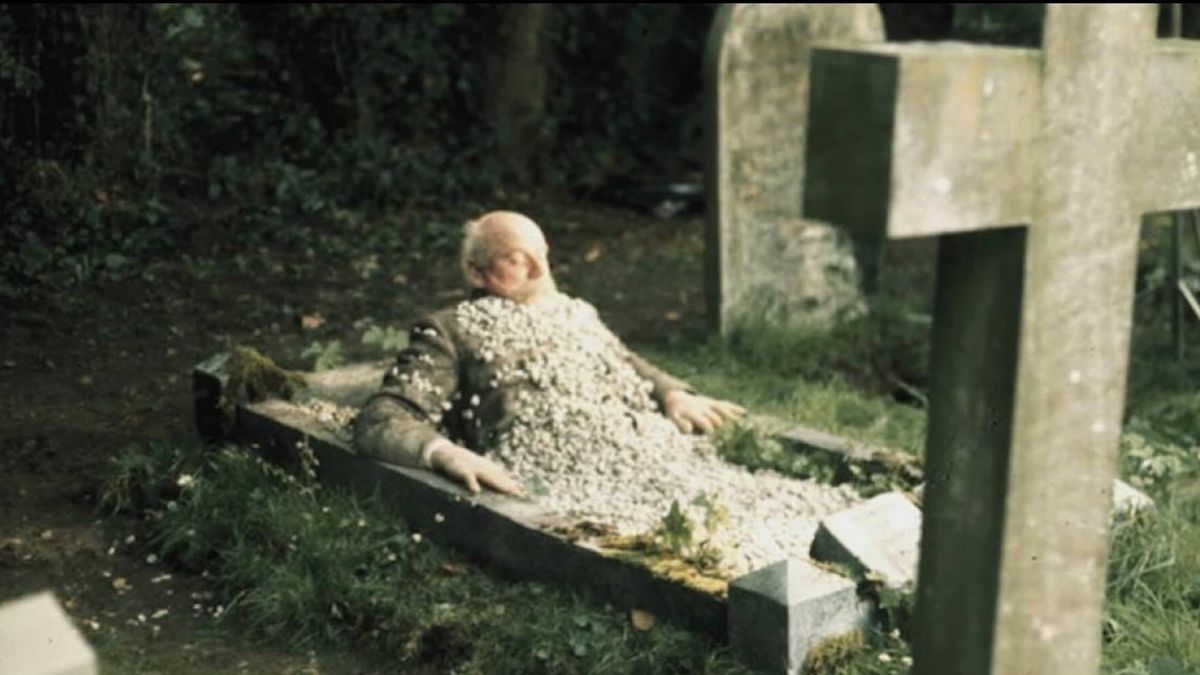
An old man tends a Suffolk churchyard. He cuts grass, works among the graves and remembers.
From this modest occupation David Gladwell constructs one of the strangest films about rural England: sixty-eight minutes in which village life, burial, agricultural labour, erotic memory and modern development no longer sit comfortably in separate times. Requiem for a Village, made with finance from the BFI Production Board and released in 1975, is often called an elegy for a disappearing pastoral England. Fair enough, though the film is rougher and less consoling than that description suggests.
Gladwell’s countryside is worked land. Woods are cut, fields cultivated, paths walked, water managed, margins kept open. Stop doing those things and the place does not remain politely unchanged for the benefit of the eye. Its ecology alters. So does its meaning.
Something closer, perhaps, to what Japanese environmental thought calls satoyama: terrain whose apparent naturalness has been produced by repeated human use.
Look at Gladwell from there and the villagers seem less like people set down in a landscape than one of the processes by which it came to look the way it does. Their gestures are in the ground.
That makes the film’s famous resurrection stranger. The dead climb from their graves without much of the theatre horror usually gives them. They are muddy, physical, awkward even. Gladwell gives them no authority from another world; they have simply come back from the local soil. The churchyard has given up part of its contents. Burial belongs here to the same material order as roots, foundations and roads. The dead occupy Suffolk.
Memory has weight, and takes up space.
Gladwell was an editor before he was widely recognised as a director — notably of Lindsay Anderson’s If.... and O Lucky Man! — and his sense of time probably owes something to that craft. Present observation, remembered village life and impossible images are laid against one another without being sorted into a tidy hierarchy. Extreme slow motion makes ordinary actions feel already recalled: bodies running, working or gathering seem to have slipped free of the practical speed at which those actions once occurred. The BFI account rightly stresses both the lingering landscape photography and Gladwell’s radical manipulation of movement.
There is an oblique parallel in the Russian village prose of the 1960s, where rural life became newly visible at precisely the moment modernisation was pushing it towards the margins.
Gladwell reaches a similar place by another road. Modernity enters Requiem through altered use: construction, machinery, roads, new houses, changed rhythms of work. The old countryside and the new development are not simply two opposing pictures. They are different ways of organising the same ground, and one is beginning to cover the marks left by the other.
The dead rise covered in local soil, without spectacle. Resurrection becomes another property of the ground.
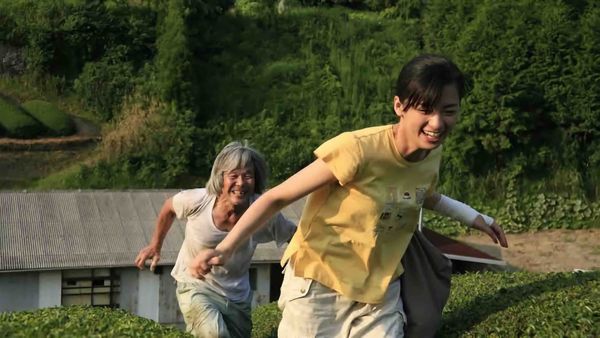
Bodies running, working and gathering are stretched until ordinary actions begin to resemble memories of themselves.
Roads, machinery and housing reorganise the same ground according to another rhythm.
Nor does Gladwell make the earlier village innocent. Sexual violence breaks any easy pastoral reading; the BFI itself flags the film’s disturbing content. The old order contained cruelty alongside fellowship, hierarchy alongside continuity. Memory keeps bad things too.
A similar principle survives in oral traditions whose continuity depends on repetition rather than preservation alone: someone has to carry the song, repeat it, write it down, keep it somewhere. Gladwell’s old man performs a smaller version of that work. He tends the graves.
Perhaps that is enough. A village survives in paths that are still walked, field names someone still bothers to use, graves that remain attached to particular people. None of this is grand. Most of it is maintenance. When the maintenance stops, the land does not forget at once; someone else begins looking after what remains.