Yuri Norstein :: Hedgehog in the Fog
Animated folk tale, fog, forest, fear and unstable perception
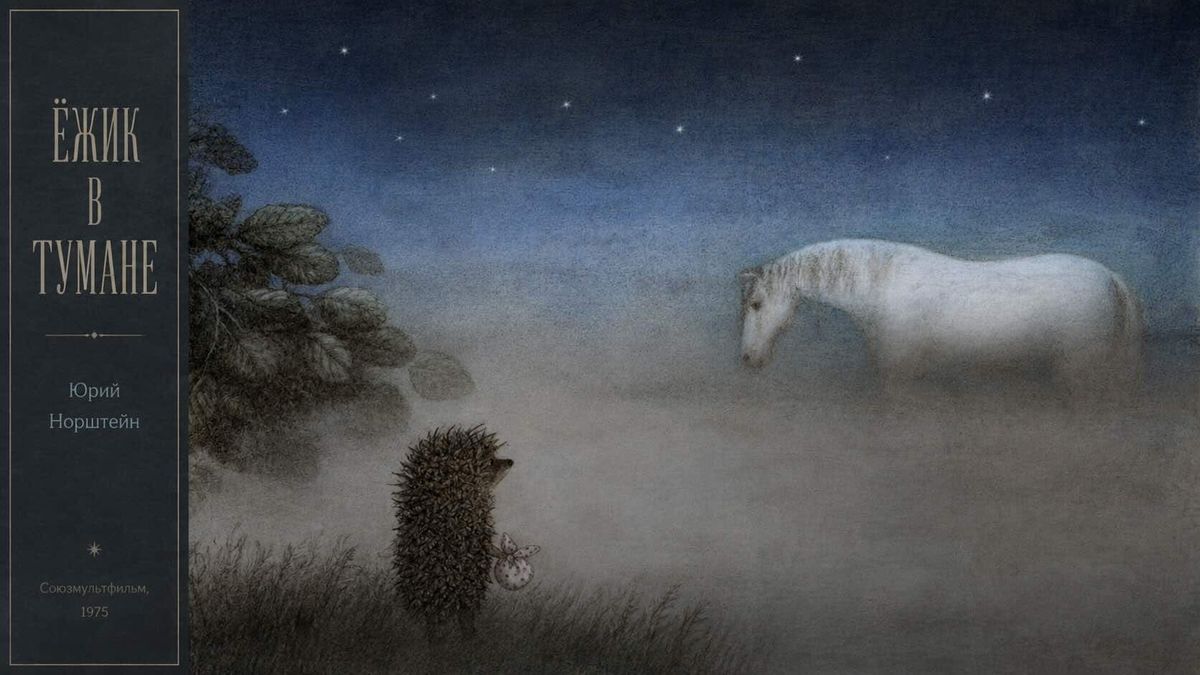
The fog is partly a sheet of tracing paper. Lift it away from the Hedgehog and he begins to disappear. Ten and a half minutes of metaphysics arrive from a very small mechanical fact.
Every evening Hedgehog goes to Bear Cub. They drink tea and count the stars. This time he is carrying raspberry jam. Then he sees the white horse below him and wonders whether it will suffocate if it lies down in the fog.
Curiosity ruins the route.
Made at Soyuzmultfilm in 1975 from Sergei Kozlov's story, Norstein's ten-and-a-half-minute film was designed with Francheska Yarbusova and photographed by Aleksandr Zhukovsky. Cut-out figures were distributed across layers of glass; tracing paper, distance, dust and actual water helped make a world in which materials keep changing without warning. The film's use of layered glass, tracing paper and real water is documented in accounts of its production.
That is more interesting than calling the film a parable about fear.
The forest remains ordinary until its optical conditions change. An owl becomes ridiculous and threatening at once. A tree arrives like architecture. The dog returning the lost jam is enormous for several seconds. Something in the river saves Hedgehog without acquiring a name.
Nothing explains itself quickly enough.
The film's strangeness is almost bodily. You wander through the fog with Hedgehog, hear the well before you understand it, meet the horse as a presence rather than a symbol, then get jolted by the dog's sudden size. The materials themselves keep shifting under you: cut-outs move through an apparent depth, then real water enters the image. That instability matters.
The world never settles into one visual substance long enough to feel safe.
I have watched this film more times than I can count, and there is still a cut, near the well, where I cannot tell whether I am looking at painted water or the real thing until the next frame proves me wrong.
This is where the film still feels peculiar. Digital compositing can imitate fog perfectly. Norstein's fog has resistance. Something physically stands between the camera and the animal.
A familiar animal partly erased by fog, visible enough to ask the question that diverts Hedgehog from the path.
Depth arrives first as sound; water remains uncertain until the image gives it back.
Suddenly enormous, then helpful: scale changes faster than Hedgehog can decide what kind of creature is approaching him.
At the end Bear Cub talks too much. Tea, fire and stars restore the evening. Hedgehog has returned, but his attention has not. He is still thinking about the horse.
The path is the same path. The forest presumably contains the same animals. Only seeing them has become unreliable.
For a film remembered as gentle childhood animation, Hedgehog in the Fog leaves an unexpectedly adult residue: ordinary things need move only a few centimetres out of perceptual alignment before they become unknowable.
The horse stays there, pale and unfinished.