Phoebe Bridgers :: Lost Weekend
Ambient pop, borrowed melodies, disappearance inside a crowded record.
Before releasing Lost Weekend, Phoebe Bridgers had people hand over their phones. Then she put the record inside planetariums.
Two excellent places for someone who has become very famous and would like, for fifty-three minutes at least, to make herself difficult to locate.
The detail would amount to little more than marketing if the record did not keep doing the same thing.
“The Outside” buries the voice under a vocoder almost immediately, a treatment that obscures identity more than it flatters the sound. Underneath are acoustic guitar, piano, Greg Leisz's pedal steel, synth guitar from Blake Mills, strings by Rob Moose, synthesizers from Jack Antonoff, Jon Brion and Ethan Gruska. On paper it already looks like a small convention of contemporary American music. In practice, though, much of that personnel is absorbed into a kind of electric fog.
It is a contradiction Lost Weekend carries through all sixteen tracks. Bridgers has never had so many people around her, and rarely sounded so interested in erasing the fingerprints.
Tony Berg and Ethan Gruska are still here; Jack Antonoff enters the production core, Alex G adds production and instruments. Then come Caroline Shaw, Chris Thile, Blake Mills, Greg Leisz, Conor Oberst, Jon Brion, Julien Baker, Lucy Dacus, Nickel Creek, Meg Duffy, Maya Hawke and quite a few others. On “I Can't Wait” there is even a singer credited as Son-John Johnson, a pseudonym many have taken to be Cameron Winter; asked directly about it, Winter preferred a joke to a confirmation.
All these people could have made a record that sounded broad, expensive, eager for you to hear its budget — and for long stretches it refuses to.
“Kill Me” is one of the first places where you notice how much the margin around the songs has changed. Bridgers still has that almost irritating ability to put an ordinary sentence in exactly the place where it becomes irreversible, but now less respectful things happen around the sentence. A guitar moves beside her, mid-heavy and treated, with that slightly dulled grain familiar from the lo-fi edge of ambient folk production.
Bridgers has said she listened to a great deal of ambient music while making the album, and only realised near the end how much “interstitial” material had entered it.
“The Governor's Waltz” is deliberately antiquated, carrying the grace of a little theatre badly reassembled after the party. “Bobby,” on the other hand, opens the walls. It is the point where the album most openly accepts the scale Bridgers now has at her disposal: large guitars, drums, strings, Caroline Shaw, and even Justin K. Broadrick of Jesu and Mike Kinsella among the guitarists. “Bobby” is beautiful, but it knows it is beautiful a little too clearly. Elsewhere the record seems faintly embarrassed by its own size. Here Bridgers simply lets it be large.
The title track offers a much stranger case.
“Lost Weekend” takes part of its melodic skeleton from Damien Jurado's “The Last Great Washington State.” Jurado has said that Bridgers texted him in the first week of February 2026: his song had lodged itself in her head during a period of writer's block, and she had begun, quite literally, to think her own thoughts inside its melody. From there came “Lost Weekend” and its reprise, credited officially to both.
Inside the same song is a sample from Paul Lansky's “Notjustmoreidlechatter,” a piece of computer music made by processing the voice until it sits somewhere between language and sonic matter — a magnificent detail buried inside an already loaded song.
One of the album's apparently most autobiographical songs exists inside a melody that first belonged to somebody else, and contains a voice processed almost beyond its status as language. Bridgers talks about herself using pieces that have already had another life. Folk borrowing, electronic manipulation and confessional songwriting end up occupying the same three minutes, and nobody involved seems to need a conference on postmodernism to justify it.
“Haunted” brings back pedal steel, mandolin, harmonica, violin and pump organ and could easily be described as a return to Americana. The vocoder is still there, together with rhythmic programming and sound design; Julien Baker and Lucy Dacus are among the voices.
“Panorama” is where the ambient fixation stops being furniture. Bridgers has explicitly mentioned Grouper and Florist when talking about the space between ambient music and songwriting that she wanted to inhabit. The track gives long stretches over to piano, synthesizers, strings and brass; the voice loses its automatic privilege as the main event.
“Still Standing” makes that choice more painful because it deals directly with her father. There is little use turning every detail into a biographical key. The record itself resists it: memory is placed beside mandolin, pedal steel, viola, synth and vocoder, then allowed to deteriorate inside the sound design.
“Never Going Back!” does something more dangerous. At the end comes an old voicemail from Bridgers' father. It is private material, unrepeatable, impossible to reconstruct in a studio. Around it sit banjo, organ, mandolin and pedal steel.
Plenty of records use voicemail as a certificate of emotional authenticity. What interests me here is the reverse problem:
The moment a private recording enters an album distributed everywhere, it stops being private forever.
Lost Weekend seems to understand the cost of that conversion.
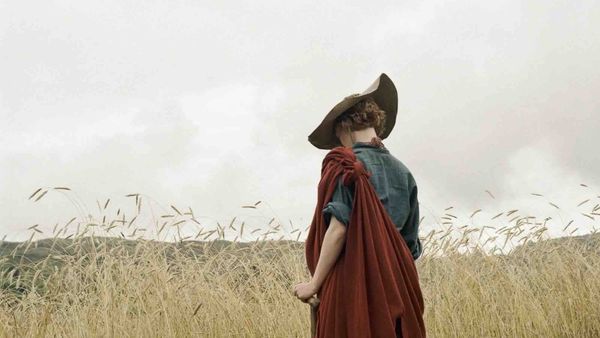
“The Outside”
Vocoder and an enormous supporting cast make the voice less identifiable precisely when the production becomes most elaborate.
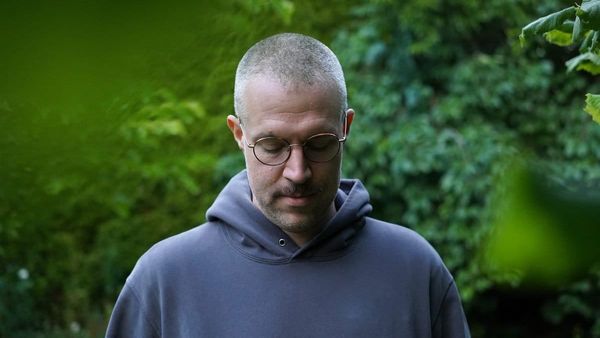
“Lost Weekend”
Damien Jurado’s melody and Paul Lansky’s processed voice place autobiography inside material that has already lived elsewhere.
“Never Going Back!”
Banjo, organ, mandolin and pedal steel surround an old voicemail whose private life ends the moment it enters the record.
Perhaps that is why “Other Plans” is so useful immediately afterwards. Phoebe at the piano; Ethan Gruska on synths; very little else. After pages of names in the credits, the space suddenly empties, and the album needed exactly that.
At fifty-two and a half minutes and sixteen tracks, Lost Weekend is not immune to excess. “Lost Boys” is an excellent single and one of the songs I find least necessary to the album's stranger logic: it knows the Phoebe Bridgers form too well, knows where to place the melodic opening, the line that will remain, the rise. It works beautifully, and that is precisely the problem.
“I Can't Wait” is nearly overpopulated: Nickel Creek, Conor Oberst on harmonica, Rob Moose, Caroline Shaw, Greg Leisz, brass, cello, double bass, electric guitars, programming, synths and the mysterious Son-John Johnson. Yet the track keeps producing a peculiar sense of distance. Like watching a crowd from the opposite pavement.
“As Above” prepares the departure, but it is the reprise that explains why Bridgers has left so many pieces open.
The final track brings back the melody received from Damien Jurado, Rob Moose's strings and Caroline Shaw. In the credits, under “vocals,” alongside Bridgers appears Maxine, her dog.
Lost Weekend was recorded between Sound City in Van Nuys, Electric Lady in New York and Tamarind in Los Angeles, mixed by Mike Mogis at ARC Studios in Omaha and mastered by Ruairi O'Flaherty at Sterling Sound. It is a record with enough infrastructure behind it to support a small industry.
Some of its songs arrive already knowing which emotion they will be expected to produce in an arena, and Bridgers is now too technically assured for the mechanism to remain invisible. At its best, though, Lost Weekend allows the song to be contaminated by what is normally supposed to sit between songs: noise, tail, sample, badly recorded voice, breathing, silence, borrowed material.
Phoebe Bridgers has returned after six years with more collaborators, more resources and an immensely larger audience. Sometimes, after all those names and studios and arrangements, she is barely there. That is usually where I want to keep listening.