liana flores :: And so it Goes...
Bossa nova, folk and art pop moving from private rooms into social life.

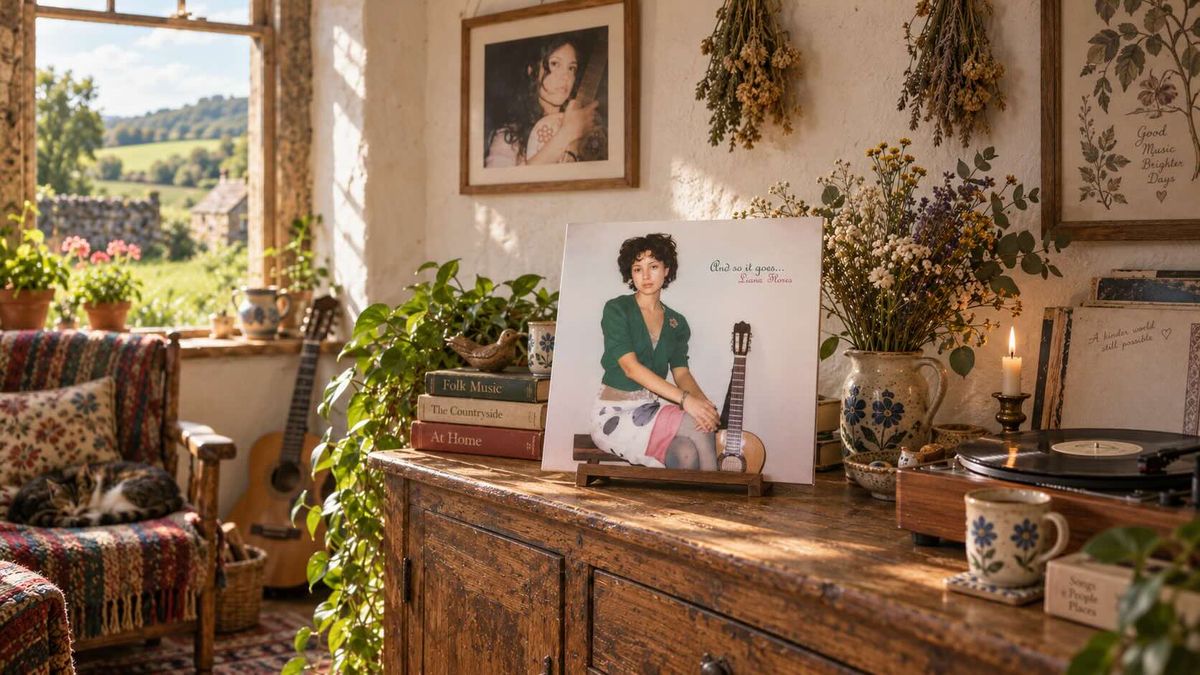
Somewhere between Norfolk and London, Liana Flores discovered that a song could leave the window open and still go out for the evening.
There's a fairly obvious story already waiting for And so it goes…. Liana Flores grew up in the Norfolk countryside, studied at St Andrews, moved to London, started touring and recorded these six songs in Los Angeles with Paul Butler. The countryside pulls back; the city arrives, people, relationships, a bit of glamour. Flores herself has described the record in more or less these terms.
The thing that has maybe changed the most compared to Flower of the soul is how these songs imagine the presence of other people. Flores has always written music able to make even very little feel inhabited: fingerpicking, a close voice, Brazilian harmonies entering discreetly inside English folk writing. Here, someone could actually dance to it. Someone could hear it arriving through an open door. Flores has said she wanted melodies she would enjoy singing, even tracks to put on while getting ready to go out. Put like that it sounds like a small thing. On the record it's felt quite a lot.
“So it goes” gets this immediately. The bossa rhythm walks light, almost with that open-porch, glass-left-half-full ease, while the song looks at one of the less graceful facts of life: someone leaves and everything else carries on with an almost irritating punctuality. Rivers keep flowing, days swap places. Flores also slips into Portuguese and the track takes on a warmer air, somewhere between bossa, sophisti-pop and that clear melancholy certain Eighties pop knew how to slip inside tidy arrangements. What works best is that the song keeps behaving well while the lyric slowly ruins its evening.
“Silvershoes” looks outward. The protagonist is a Hollywood waitress who sees a pair of silver shoes and for a few minutes starts treating them as a way out. It's a fantasy almost obvious in its simplicity. Flores puts it inside one of the EP's most openly pop melodies, with an arrangement that lets things shine just enough to make clear why someone might believe it. The shoes, in the end, do more work than any big statement: they're enough to shift the centre of the day.
That new social confidence gets stranger on “Gemini.” Flores drops the register of her voice and the EP picks up a bit of shadow. Up to that point her lightness could seem fragile; here it becomes harder to read it that way. The lower register gives the melody more weight and slightly throws off the record's balance. The city, evidently, doesn't only bring light. The melody feels unmistakably hers, perhaps even already encountered somewhere along the way. It hardly matters. It's beautiful.
“So mysterious” is the point where Flores most openly tests what happens when her music has to move a body. She wanted something more energetic for the live set and the bossa's gait gives way to funk. Bass and rhythm become more present, and Flores keeps singing as if there were no reason to raise her voice just because everything else has started moving on the more crowded summer nights.
“Here to stay” slows that push back down. Flores has jokingly described it as Carole King after a sedative, and I hear something of early Everything But The Girl in it too, of The Style Council, of that early-Eighties British jazz-pop where piano, soft harmonies and adult songwriting could still stay light. The track seems to know that vocabulary well: broad chords, measured phrasing. After “So mysterious,” it almost gives the impression of having left the party an hour before everyone else.
“So it goes”
Bossa rhythm, Portuguese and a melody that keeps its composure while the lyric watches somebody leave.
“Gemini”
Flores drops into a lower register and gives the EP its first real patch of shadow.
“So mysterious”
Bass and funk push the music towards the dance floor without asking the voice to become louder or less itself.
“The way I say goodbye” throws it all back into question. Loss, disappointment and abandoned expectations are handled with a directness Flores usually tends to screen. By this point the EP is already far from the girl watching the world carry on after someone's departure.
Saying goodbye has become something you do.
Bossa nova, folk, Brazilian pop, pastoral songwriting: all still useful definitions, up to a point.
The record seems more interested in seeing what happens when that vocabulary, built partly in solitude, gets taken outside.
That's mostly how the city gets in. In the bass that anticipates movement. In melodies someone could actually sing along to. In a pair of shoes able to hold another biography for a few seconds. Even the old lightness of bossa changes function once these songs start thinking about stages, strangers, evenings out.
And so it goes. By the end the title feels almost like a simple statement of fact. Things carry on. Meanwhile, without much noise, they change shape.